

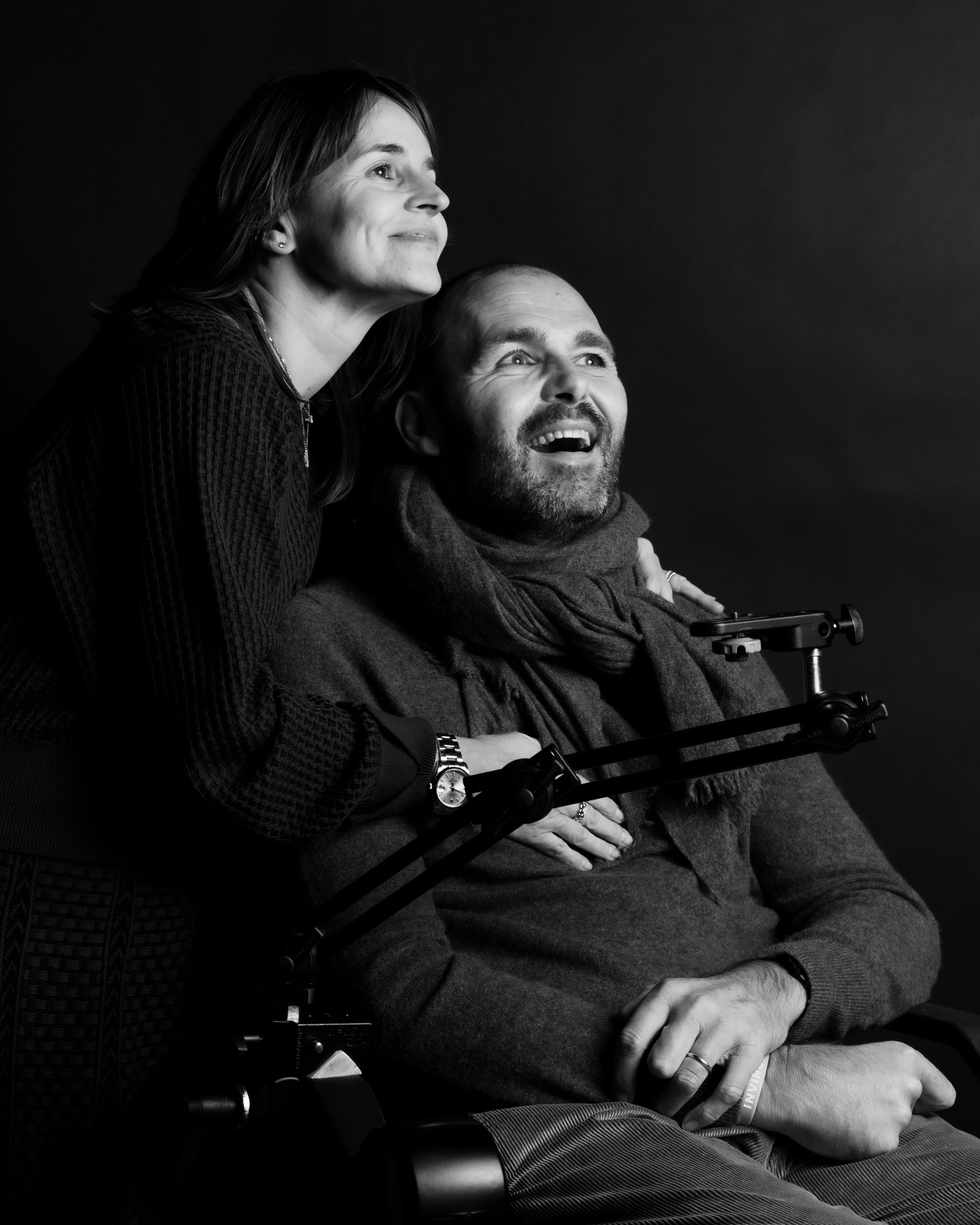
A conversation about Courage of Living and Living with Courage between ALS patient Olivier Goy and former CBS 60 minutes producer Magalie Laguerre-Wilkinson.
When French entrepreneur Olivier Goy wheeled himself into a Manhattan midtown boardroom, an East Village art gallery, onto the stage of a business conference, or into the lobby of a New York landmark, he somehow elevated everyone around him — even now, especially now.
New York felt it. The bold celebrity names — among them award-winning actor Jean Reno, bestselling author Marc Levy, illustrator and Paris Match cartoonist Pauline Lévêque, painter Paige Boller, Tastings‘ owner Alexandra Morris, French Morning editor Elisabeth Guedel, Fortune editor Diane Brady, Frenchfounders President Benoit Buridant, Paris Brain Institute America board member Zofia Reno. The anonymous ones too: Anissa, Ela, Anthony, Claire, Philippe, Jessica, Stéphanie, Julien — dozens really — including an NYPD officer who stopped to watch.
Did they know that Olivier, whose voice and movement were stolen a few years ago by an incurable disease, would make them ‘visibly’ invincible?

For two intense days, on November 18 and 19, 2025, Olivier Goy turned the city into a living laboratory of courage, feast, and purpose.
At Alphabet Studio in the East Village — Gwendoline Finaz de Villaine’s iconic art studio / gallery — at the Transatlantic Leaders Forum hosted by frenchfounders, and inside CIC / Banque Transatlantique’s boardroom, he spoke (through his AI-recreated voice) about purpose and photographed New Yorkers for La Fresque Généreuse, the monumental mural he is building to fund brain research.
“‘Now let’s be crazy’! New Yorkers never disappoint when we ask them to let go at the end of a photo shoot,” he joked on Instagram. And they didn’t: during these two days, Olivier Goy and Paris Brain Institute America, led by publisher Martine Assouline, raised more than $50,000 in new donations to advance brain research.
What followed was not just inspiration. It was strategy. With his hands, his eyes and his smiles standing in for the sound of his voice, Olivier showed how vulnerability fuels leadership, how purpose scales, how love — yes, love — sustains every transformation worth making.
Below, you will find some of the black-and-white portraits of New York donors Olivier took, armed with his Leica SL2 — and the full transcript of his on-stage conversation with Emmy Award winner Magalie Laguerre-Wilkinson at the Transatlantic Leaders Forum — a conversation Frenchfounders framed under a powerful theme: Courage of Living and Living with Courage.
“For a long time, I thought courage meant… fighting,” he told the hundreds of entrepreneurs, corporate leaders, and investors in the room. “You know — staying strong, keeping control, never giving up. But then the illness came along — and it quietly rewrote the definition. ALS takes away your strength, your voice, bit by bit. And suddenly you understand, courage isn’t in the muscles. It’s somewhere else.”
Olivier Goy, a successful tech entrepreneur for whom life once mirrored the contours of an American dream — a loving spouse, two kind and brilliant children, a thriving company — saw his entire perspective change when the disease appeared. The first symptoms surfaced during a tennis game, and months later doctors delivered the verdict: ALS, also known in the United States as Lou Gehrig’s disease. The ice-bucket challenge — suddenly no longer symbolic. An awakening. A sentence to become gradually imprisoned within one’s own body.
A life punishment unlike any other.
Olivier Goy decided he would not be punished twice. He has engaged with his ALS in an infinite dance — a choreography of resistance, acceptance, and action that only he could inspire.
As the disease stole his voice, he refused silence and instead became one of the most vocal activists for living with a handicap, for ALS, and for brain research. He has raised over two million dollars, inspired a documentary (Invincible Été, premiered in New York in January 2024), co-authored a book (Invincible with Le Figaro journalist Anne Fulda), and is creating La Fresque Généreuse, a 200-square-meter mural composed of portraits of donors and scientists, designed with Vahram Muratyan, author of Paris Versus New York.


Seated in his wheelchair, Olivier — now an Ambassador for Paris Brain Institute — took portraits one after another. At Alphabet Studio, he lifted so many spirits that New York seemed to drift back into a time of endless, underground lightness. At the BNP Paribas tower on 7th Avenue, where the Transatlantic Leaders Forum was held, business leaders donated and stepped in front of his camera — moved by the words spoken through the AI-generated version of his voice. At Banque CIC / Transatlantique, his silent face suddenly erupted into loud laughter when he spoke about love — about his family, and about his wife Virginie, seated beside him.
Olivier and Virginie made hundreds of invincible New Yorkers visible.
So, I captured a few candid pictures of them on Fifth Avenue and behind the scenes. And I decided to share Olivier’s answers to Magalie’s questions with you so that you can see Olivier and Virginie and hear his words.
Take your time with it.
Share it with someone you love.
Let it set the tone for the holiday season ahead: a reminder that life demands a daily celebration.
Become Visibly Invincible.
JC Agid
And if you can, join us and Olivier in supporting brain research. One in three people worldwide will be affected by a brain disorder — including the 5,000 Americans diagnosed with ALS every single year. Donate here: https://parisbraininstitute-america.org/
Or if you are in Paris, join a photoshoot with Olivier Goy for La Fresque Généreuse: https://www.invincible-ete.com/la-fresque.
You can also reach out directly to us – you can contact me through this website or by email: info@parisbraininstitute-america.org

Magalie Laguerre-Wilkinson: Olivier, to pick up on a part of the title of this interview: when you hear the phrase “living with courage”, what does it mean to you today?
Olivier Goy: You know — staying strong, keeping control, never giving up.
For a long time, I thought courage meant… fighting.
But then the illness came along — and it quietly rewrote the definition.
ALS takes away your strength, your voice, bit by bit. And suddenly you understand, courage isn’t in the muscles. It’s somewhere else.
Real courage, for me now, is… to accept.
To stop resisting what’s happening, and instead, to inhabit it differently.
To turn fear into movement, and fragility into meaning.
It’s not a noisy courage anymore. It’s a calm one.
The kind that whispers every morning:
Okay… I can’t do everything I used to. But I can still love. I can still act. I can still make a difference.
That’s my fight today — a peaceful fight.
Maybe, the bravest thing I’ve ever done is simply to keep saying “yes” to life, even when life says “no.”

When you were first diagnosed, did courage feel like something you had — or something you had to learn?
At first, I really thought I had courage.
I’d been an entrepreneur for years — taking risks, making tough calls, living with uncertainty.
So, when I got the diagnosis, I told myself, okay, you’ve trained for this. But very quickly, I realized… no. This was another world.
There’s no plan, no control, no winning strategy. Just… letting go.
So yes — I had to learn courage. From scratch. A completely different kind of courage — not the one that pushes forward, but the one that accepts. The one that says, I can’t fix everything, but I can still choose how to live it.
And you know what?
I also had to learn something I never imagined doing — asking for help.
At the hospital, I started seeing a psychologist.
Me! I’d always thought therapy was for the weak.
But she saved me. Truly. She helped me put words on what I was feeling — and gave me permission to fall apart a little, before standing up again.
In the beginning, I kept repeating, stay strong.
Now, I tell myself: stay open. Open to others, to love, to what’s still possible — even when it hurts.
That’s the courage I had to learn.
Softer, yes. But deeper. And probably the most humankind.
How has your definition of courage evolved since then?
It’s changed completely.
Before, courage for me meant doing.
Running companies, making decisions, staying in control. I thought being brave was about keeping everything together — never showing a crack.
But when the illness came, it took away all that control.
My body stopped obeying. My voice — my real one — disappeared.
And suddenly, I had to find courage somewhere else.
Now, courage isn’t about doing anymore. It’s about being.
Being present. Being honest. Being vulnerable.
Courage, today, is saying: I’m scared. Or I don’t know. Or I need help.
It’s the courage to be seen — even in your fragility.
The illness stripped away the surface — the noise, the ego, the speed.
And underneath, I discovered something softer… but stronger.
Courage is to love when you could close off.
To smile when you could give up.
To keep saying “yes,” even to what hurts.
And sometimes, it’s simply to keep speaking — even through a synthetic voice — because behind that voice, there’s still a beating heart.


You were already someone who built things, who took risks, who led with vision. Has ALS changed the way you think about achievement or purpose?
Before ALS, achievement meant building, growing, reaching goals. I measured life in projects, numbers, results — the way many entrepreneurs do.
And I loved that energy, that feeling of creation and momentum.
But the illness slowed everything down.
It forced me to ask: what’s left when you can’t run anymore?
When you can’t “build” in the same way?
That’s when my definition of purpose changed.
Now, achievement isn’t about how much I do, but about what I awaken in others.
A feeling, an idea, a bit of courage.
If someone leaves a conversation with me wanting to love more, to act, to help — that’s success.
As ambassador for Paris Brain Institute, I’ve had the chance to turn that idea into action. We created the Invincible Été Fund, a new philanthropic model that mixes finance and generosity — with the goal of funding neuroscience for the next 99 years.
We launched the Fresque Généreuse, a giant mosaic of more than 3,000 portraits to raise funds and awareness for brain research.
We built bridges between European researchers through CURE-ND 4 ALS, an alliance uniting France, Germany, the UK and the Netherlands against ALS.
And even a bit of poetry — a film, Invincible été, and a campaign with publicist Jacques Séguéla that turned my story into a collective message of hope.
So yes, I still build things — just differently.
I build connections, movements, hope.
Before, I wanted to succeed. Now, I want to be useful.
That’s my new kind of entrepreneurship — one that measures its return in humanity… and dollars for research!


What surprised you most about yourself in this journey?
Yes — and that’s something that really changed me.
When I decided to speak openly about my illness, I didn’t expect what came next.
Suddenly, people started writing to me — hundreds of messages. Strangers, friends, colleagues… they told me about their own hidden struggles: depression, burnout, grief, illness, fear.Things they had never shared with anyone.
And little by little, I became a kind of confidant.
It was humbling — and eye-opening.
I realized how many people live with an invisible weight, and how few spaces there are to talk about it without shame.
It made me understand something essential: everyone is carrying something.
And that doesn’t make us weaker — it makes us human.
Since then, I’ve stopped looking for heroes who never fall.
I’m more interested in those who dare to stand up after falling — and who help others do the same.


When so much is out of your control, what helps you still feel agency — or freedom?
That’s a beautiful question.
When you lose control of your body, you realize that freedom has nothing to do with movement.
It’s something inside.
At first, I thought I had lost everything — the ability to walk, to speak, to act quickly.
But slowly, I discovered another kind of freedom: the freedom to choose how I respond.
I can’t choose what happens to me — but I can choose what I do with it.
And that’s where my agency lives now.
I still have freedom in my mind, in my heart, in my intentions.
I can decide to turn this illness into something useful — to raise awareness, to help research, to inspire others to keep going.
That’s not a physical freedom — it’s a moral and emotional one.
And then, there’s technology — my voice today is synthetic, created by AI.
But paradoxically, it’s given me back a form of independence. It allows me to keep speaking, to keep creating, to keep connecting with people.
So yes, I’ve lost control over many things… but I’ve gained a deeper freedom: the freedom to stay myself.
To love, to act, to leave a trace — even differently.


Are there moments of joy, humor, or unexpected beauty that have become especially meaningful?
Yes — more and more, actually.
When everything becomes fragile, the smallest things take on a new intensity.
A sunrise. A song shared with my sons. A message from a stranger who says, “your story helped me.”
Even a moment of laughter in the hospital — and there are many — becomes a small victory.
Humor, for me, is a form of survival.
It breaks the tension; it reconnects us to life.
Sometimes my friends and I make jokes about my robotic voice or my wheelchair — it’s our way of saying: the illness doesn’t get to take everything.
And beauty… beauty has become everywhere.
In the people who help me each day, in the creativity of our projects, in the way fragility can bring out tenderness in others.
Before, I used to chase beauty.
Now, it comes to me — quietly — when I pay attention.
So yes, joy and humor are still there.


Courage rarely exists alone. Who or what gives you courage on difficult days?
So true — courage never walks alone.
On difficult days, mine comes above all from the people around me.
From my wife Virginie — her strength, her humor, her calm presence.
From my sons, Clément and Louis — they remind me that life keeps moving forward, that love is stronger than fear.
From my friends, my team, the doctors, the caregivers — all those who stand beside me without pity, but with light.
There’s also the community of patients and researchers I work with through the Paris Brain Institute.
Seeing their dedication, their hope, their fight for others — that gives me courage every single day.
And sometimes, courage comes from very simple things: a song, a child’s smile, the feeling of sunlight on my face.
Moments that whisper, you’re still alive, and that’s already enough.
But above all, what gives me courage is this conviction that everything I’m living can still be useful — that my voice, even synthetic, can serve something bigger than me.


How has your relationship with your loved ones — or with friendship — changed?
My relationships have changed completely.
Because when you live with a disease like this, people around you also have to learn.
There are those who have learned — my wife, my sons.
They’ve learned a new language of love, one made of silence, patience, humor.
They’ve accepted the reality with me, and that gives me incredible strength.
There are those who are learning — friends, colleagues — who sometimes don’t know what to say, but who stay, who try, who show up. And that effort alone is beautiful.
And then there are those who look away.
Not out of cruelty — out of fear.
Because facing fragility, facing mortality, it confronts them with their own.
I understand that now. I used to look away, too.
This illness taught me compassion — for others, and for their silences.
Not everyone can walk beside a condemned man… but those who do, even for a few steps, make the road brighter.
What have you learned about receiving help, when you’ve spent a lifetime being the one who gives it?
You know, when you ask me what I’ve learned about receiving help… I’d rather answer by reading a short passage from my book.
It’s called “Another Planet.”
Another Planet
The day you cross into the world of dependence, you land on another planet. You have to rethink your whole relationship with your body, with modesty, with privacy.
This chapter, probably immodest, I chose to assume — both to help those making this same journey, and to pay tribute to those who have made caring for others their profession.
I should probably say those women, since so many of them are — nurses, caregivers, aides— still overwhelmingly women.
My first contact with this planet was in the hospital, when they placed my first feeding tube.
A nurse I had never met before walked into my room, already heavy with the suffocating morning heat of that old neurology ward.
“Mr. Goy, it’s time for your shower!”
Without a word, I found myself a few minutes later sitting naked, a towel on my knees, on a plastic wheelchair — probably bought second-hand in the USSR.
The nurse struggled to push my ninety kilos, the wheels screamed with age, down a corridor where no one seemed surprised to see me rolling by in my birthday suit.
It was all part of a well-rehearsed morning ballet.
We waited, in silence, for a cubicle to free up.
A frail old man came out. Our turn.
Still without a word, the water started flowing, washing away the traces of a too-hot night.
Then suddenly, a sentence burst out: “I really loved your film. I’ve told all my patients to watch it when they feel down!”
By then I could no longer speak, but she must have read the mix of surprise and amusement in my eyes — this absurd situation of being scrubbed vigorously on the backside with a disposable glove.
I started laughing uncontrollably. She did too.
Here, the relationship to the body is unfiltered, direct.
No protocol. No modesty. No pretense.
A long way from Instagram’s beauty filters.
I remember perfectly the embarrassment I felt during a small sanitary accident — I’ll leave the details to the reader’s imagination.
My face must have betrayed my shame; I looked like Droopy on a bad day.
The nurse met my eyes with kindness and said:
“Did anyone die? No? Then it doesn’t matter!”
That line, so simple on the surface, left a deep mark on me.
It still echoes inside me with a force far beyond its plain words. As if I suddenly understood that whatever pain my body might inflict on me, beauty was elsewhere.
My intimacy, my personality, now live in the only place my illness will never reach: my mind.

You’ve been very engaged with technology and research around ALS. What developments or ideas give you real hope right now?
That’s a question I love — because yes, there are real reasons for hope.
For the first time, science is moving faster than the disease.
We’re beginning to understand what causes ALS — not just the symptoms, but the mechanisms at the cellular level.
There are now dozens of clinical trials happening around the world, and new therapies that target specific genes or pathways.
It’s still early, but the progress of the last ten years is greater than that of the previous fifty.
At the Paris Brain Institute, where I’m an ambassador, we’re supporting extraordinary teams — scientists, clinicians, data experts — who work hand in hand with patients.
And that collaboration is new.
What gives me hope too is technology — AI, for example, has already changed my life. Thanks to incredible researchers at Kyutai, we created Invincible Voice, a prototype of an intelligent vocal assistant designed for people who’ve lost the ability to speak. The idea that a voice — even synthetic — can carry emotion and personality gives me goosebumps.
Because it means technology can serve humanity at its most fragile.
And beyond that, there’s this incredible alliance we launched — CURE ND 4 ALS — bringing together the best European research centers to share data and trials.
It’s a game changer: for once, we’re not competing, we’re collaborating.
So yes, I’m realistic… but deeply hopeful.
Because the day science finds a cure — and it will — it will be thanks to this mix of intelligence, cooperation, and dollars!

If you could speak directly to the researchers and policymakers working on ALS, what would you want them to remember?
I would tell them: never forget the human behind the data.
Behind every neuron, every biomarker, every line of a clinical report, there is a person — a voice, a family, a story that’s still unfolding.
Your work is not abstract. It’s someone’s hope, someone’s tomorrow.
I would also tell them: collaboration is the cure before the cure.
We can’t afford silos anymore — not between labs, not between countries, not between the public and private sectors.
When you share knowledge, you accelerate life.
And to policymakers, I would say: time is the enemy.
For ALS patients, every month counts.
Help us shorten the paths between discovery and treatment.
Simplify access to trials.
Support research that takes risks.
Fund the brilliant minds who could one day make this disease history.
Science is progressing fast — faster than ever.
But we need the courage to keep up with it, and the humanity to guide it.


Back to the “courage of living”, when you wake up in the morning, what makes you feel alive?
What makes me feel alive this morning?
Honestly? The blueberry pancakes at the hotel buffet!
I’m serious! They are so delicious!
What do you want people to take away — not just about ALS, but about living?
If there’s one thing I’d like people to take away, it’s this: you don’t need to be sick to wake up.
My story isn’t just about ALS — it’s about life.
About how fragile it is, and how beautiful it becomes when you finally stop pretending it’s endless.
I’d love for people to remember that every moment counts — the ordinary ones, especially.
That success isn’t about speed or power, but about presence.
That you can lose almost everything — your voice, your body, your freedom — and still keep the essential: your ability to love, to connect, to find beauty.
ALS took a lot from me, yes.
But it also gave me clarity.
It taught me that fragility isn’t the opposite of strength — it’s the source of it.
So what I hope people take away is simple:
Live fully, now.
Say “I love you” more often.
Forgive faster.
Laugh louder.
And never forget — courage isn’t about avoiding the fall.
It’s about learning how to rise, again and again, with love.


With his hands, his eyes and his smiles standing in for the sound of his voice, Olivier showed how vulnerability fuels leadership, how purpose scales, how love — yes, love — sustains every transformation worth making.
And if courage had a voice, what would it whisper to you today?
If courage had a voice…
I think it would whisper something very simple.
It would say, “You’re doing fine. Keep going.”
Not faster, not harder — just keep going.
It would remind me that courage isn’t noise or strength.
It’s the quiet breath that says yes when everything feels heavy.
It’s the small flame that keeps burning even when the wind rises.
It would also whisper, “You’re not alone.”
Because courage doesn’t live in isolation — it moves from one heart to another.
From my wife, my sons, my friends, to me — and hopefully, from me to others.
And maybe — just maybe — it would end with a smile and say: “Have a pancake.”
Because courage also knows how to laugh.
Conversation reproduced with the authorization of Magalie Laguerre Wilkinson and Oliver Goy. All portraits by Olivier Goy (c) Olivier Goy / Paris Brain Institute ; all other pictures (c) JC Agid
A special thank you to those who made these two special days with Olivier and Virginie Goy possible: Alexandra Morris and Tastings; Pauline Vranken and Vranken Pommery America; Julien Alamo and Picto New York; Benoit Buridant and Frenchfounders along with Géraldine Le Meur, Paul Papadimitriou, Thany Brunner-Vinh, and Simone Sfeir; Alexandre Chasseriaud (Banque Transatlantique) and Guillaume Lanoé (CIC).

Leave a Reply