


A Conversation with Franco / New Yorker Artist Gwendoline Finaz de Villaine
When I first moved to New York nearly thirty years ago, few people ventured beyond Avenue A, at the far end of St. Mark’s Place in the East Village. Marked by the letters B, C, and D, the avenues formed an increasingly forbidden territory, a Far East inhabited by crack dealers alongside writers, painters, muralists, and punkers drifting through the streets. Charlie Parker, Jean-Michel Basquiat, and Keith Haring all lived there.
In a city since transformed, Alphabet City has mellowed; doors have opened. Yet within its grid of streets, a sense of resistance still lingers — musicians in Tompkins Square, perhaps poets, gardeners, bars, and sidewalk cafés, all bearing witness to an unfinished history.
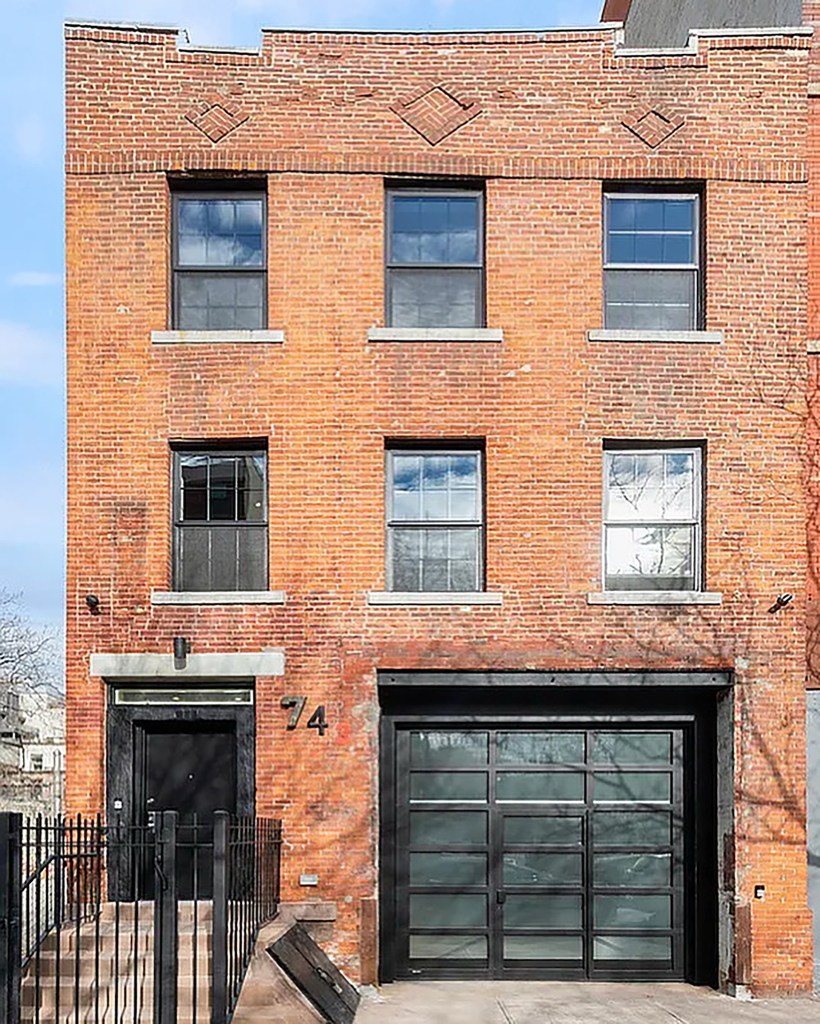
It is on East 6th Street, between Avenues C and D — in this urban world made of letters and numbers — that a Franco–New York based artist has opened the Alphabet Studio: a space with two faces, half gallery, half studio, conceived as an inner passageway, perhaps ephemeral yet alive, shaped by the poetic and engaged universe of Gwendoline Finaz de Villaine. With its white brick walls and dark beams, an old factory organized as an elongated room, the place seems to stand in quiet opposition to the well-behaved galleries of Chelsea, on the other side of the island.
The Alphabet Studio is meant to be a place of audacity and creative disobedience.
Gwendoline Finaz de Villaine

How many times had Gwendoline and I found ourselves side by side, without ever actually meeting, until that dinner last June, in a distant Brooklyn apartment? Lucien Zayan, founder of The Invisible Dog, was cooking, and around the table Marie de Foucaud had gathered a few friends. Among them that evening were Julien Alamo, director of Picto America, Katherine Fleming, president of the Paul Getty Trust, and — almost directly across from me — Charles, Gwendoline’s husband; I was seated beside her.
Very quickly, she told me that nearly twenty years earlier she had spent an entire summer working at 972 Fifth Avenue — the French Cultural Services, now known as Villa Albertine — an institution I myself had left only weeks earlier after more than four years of service. One summer apart, we might have met. A year before, we had even attended the same wedding in France, in the countryside north of Paris, without ever knowing one another.
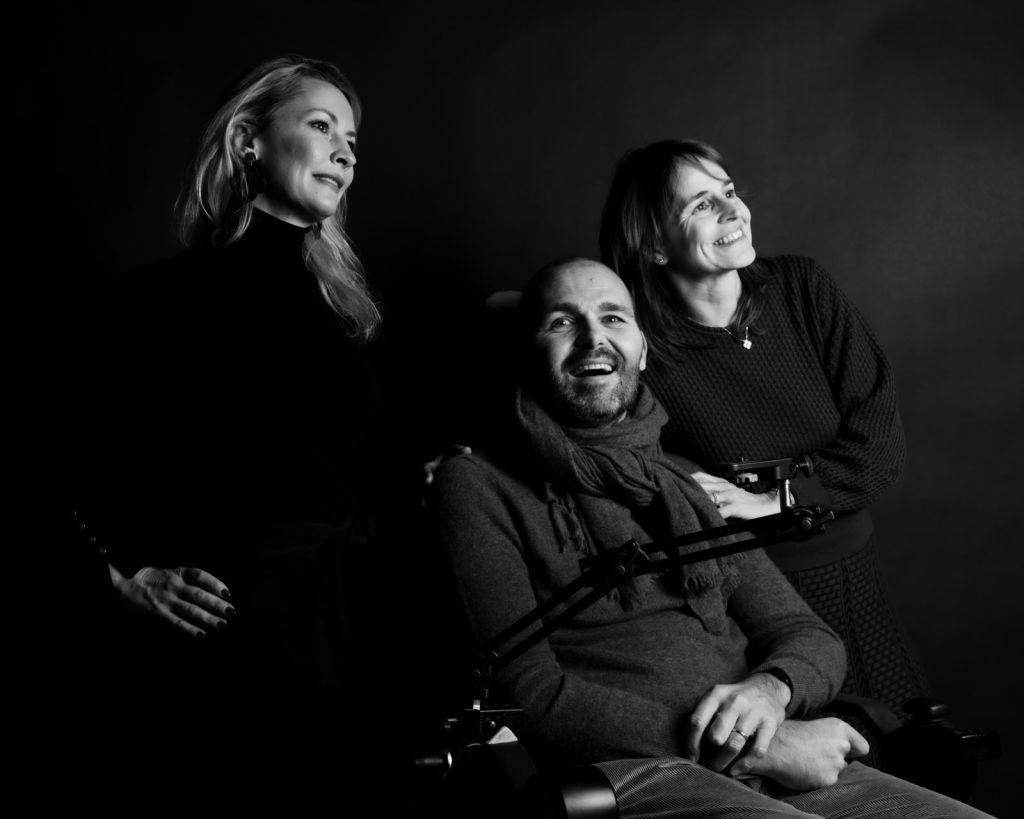
Since that dinner, we have worked together, creating a temporary photography studio for Olivier Goy, the French ALS patient and activist engaged in creating La Fresque généreuse, a large mural to be installed on the walls of the Paris Brain Institute in support of brain research. A few weeks later, Gwendoline invited me again, this time on a more personal mission: to capture, through photography, fleeting moments of Alphabet City and New York.
“In black and white,” she specified, “to be shown, as a guest artist, at my first exhibition at the Alphabet Studio.”
The exhibition, on view through February 28, 2026, is titled Dreamcatchers. It features recent works by Gwendoline, who, together with her husband Charles and their two children, left the bourgeois serenity of the Upper West Side for the more bohemian life in the east of the East Village — where, for more than two centuries, the avenues have belonged to the first four letters of the alphabet.


I felt the urge to interview this artist, who chose the life of a performer at the Folies Bergère over a career in “business,” and ask her to describe her idea of ‘the dream.’
What follows are fragments of a disjointed conversation. To be read slowly, as a dream unfolds, fades, and returns unexpectedly.
And if you find yourself in New York, wander through Alphabet City. There, between two letters, at 743 East 6th Street, you will find the artist, now my friend, Gwendoline Finaz de Villaine and her Alphabet Studio.
Ring the bell, step inside, and dream in your turn.
JC Agid: A dream. Dreaming. Catching a dream. Is that the very spirit of the Alphabet Studio you’ve just opened?
Gwendoline Finaz de Villaine: The Alphabet Studio is meant to be a place of audacity and creative disobedience.
Everything is in the quote I tagged on a participatory panel at the entrance: “In New York, I take my dreams for reality.”
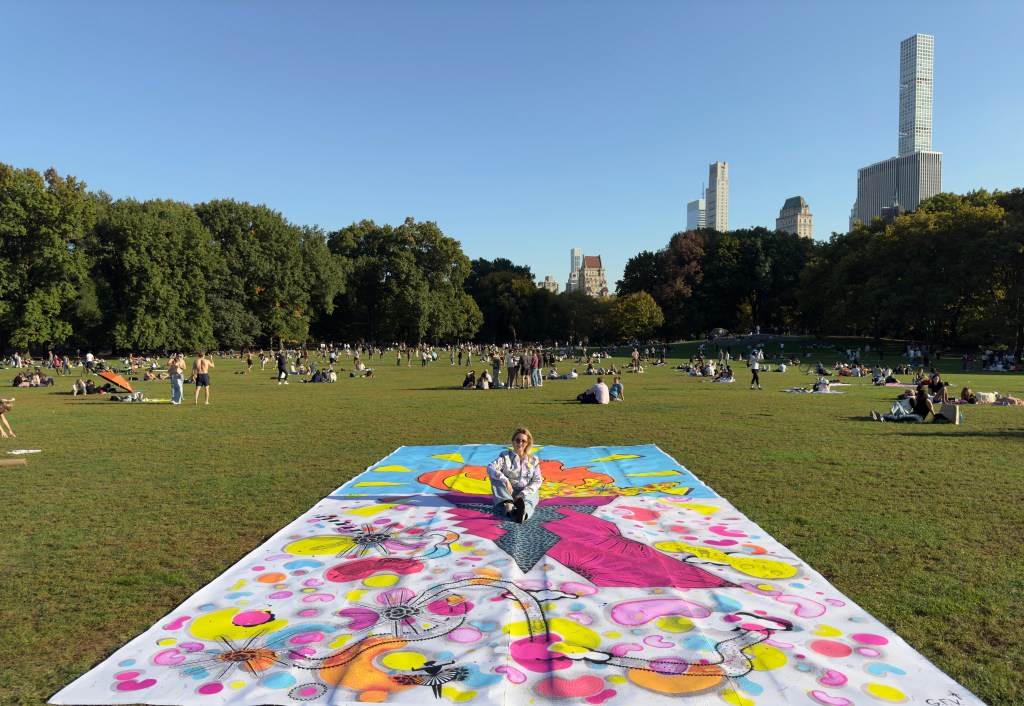
It began with the deployment of a clandestine mural in Central Park. For me, it was an act of total freedom and boldness. My daily mantra comes from Goethe: “Whatever you can do, or dream you can do, begin it. Boldness has genius, power, and magic in it.”
What was the idea behind that mural? Murals seem to be a recurring form of expression in your work.
It was a tribute to the relationship between France and the United States, in the year of the Paris Olympic Games. I wanted to evoke the gift France made with the Statue of Liberty at the beginning of the 20th century, and to nod to that symbol of light, which I see as a guiding thread of Franco-American friendship.
How did the public react to this act of what you call “creative disobedience”?
For me, it was an installation that returned to the roots of street art: a fleeting, unauthorized gesture that claims urban space. Using the city as a vast open-air gallery.
“Unauthorized”. Meaning: alone and without the city’s approval?
People had offered to help, and some suggested doing things by the book. But no. There were three of us. We arrived with a truck, unrolled the mural like a giant carpet, surrounded by young people sunbathing at Sheep Meadow. People were delighted. Everyone had a smartphone in hand, asking questions. It was a direct connection with the New York public.
An artistic installation as a space for improvised dialogue.
A dialogue with art students. And also with a Parks Department officer who let us continue, as long as we didn’t damage anything and stayed “in service of beauty.” As the singer Zaho de Sagazan puts it, “as long as you don’t cause harm.”
The officer was genuinely delighted. He even told me he’d love to see something like this happen every week.
Breaking — or ignoring — legal or social codes.
That’s what I call creative disobedience. Disobedience for the sake of anarchy can be interesting, of course, but for me it isn’t enough. I want to disobey in order to rewrite the rules.

The Alphabet Studio stands at the heart of a neighborhood of resistance.
Gwendoline Finaz de Villaine
Your path is itself a series of unexpected, unpredictable choices. With your business school background and your studies in political science, you could have led a publicly traded company — instead, you became an artist.
I left the business school HEC to become a singer and a revue performer. With every detour I took, I found greater joy and deeper enrichment.


Triptych, Acrylic and Ink on linen Canvas, 180x72x11/2”, 2025
But why break the rules rather than follow them?
If we were art lovers devoted only to what already exists, we would do nothing but repeat and recycle history. That’s why I question graphic forms. I live in the East Village, and I look at the tags around me. What new language are we going to invent in the street, in the urban space?
Disobedience is necessary today. Otherwise, we remain in service to our predecessors, our ancestors, those who achieved great things before us. But that’s not the most interesting part.
What matters is inventing our own imprint on the world.
Is it about leaving a mark, or about creating another dimension, both urban and human?
What remains? When you write a book, it remains forever. A painting also remains forever. For me, leaving a mark means inventing a new alphabet, one powerful enough to endure across decades.
Disobedience for the sake of anarchy can be interesting, of course, but for me it isn’t enough. I want to disobey in order to rewrite the rules.
Gwendoline Finaz de Villaine
If you allow me to share a thought within our conversation: artistic expression here serves as a pretext for engaging differently. The Alphabet Studio asserts itself not only as an exhibition space, but also as a place for dialogue in a neighborhood shaped by a strong, artistic, and at times violent, history, one that has preserved a distinct identity, somewhat protected from the gentrification transforming so many parts of Manhattan.
The Alphabet Studio stands at the heart of a neighborhood of resistance.
There is an urban mural project that brings residents together to honor figures who have shaped human rights or cultural creation. People in the neighborhood tell me this is a place where immigrants are still welcome, where anarchists and artists are welcome. It is a neighborhood of resistance, with community gardens, and with residents pushing back against real estate developers so churches are not torn down to make way for new buildings. It is a protected area, remarkably resistant to New York’s culture of transaction.


fund raiser for Paris Brain Institute America | November 2025
Your first exhibition is called Dreamcatchers. What does a dream represent for you, having studied political science and business at top French schools, grown up in a fairly privileged family, explored cabaret, as the granddaughter of a singer, and then suddenly chosen visual art as your primary mode of expression?
Is it a way of escaping where you come from?
I am not escaping. I was fortunate to grow up in a family where creativity was actively encouraged and valued. I was allowed to cut up attic curtains to make bags and cushions. I painted and drew all day long.
The house of my childhood, in Seine-et-Marne, stood on an island, a place of creativity and hospitality, where my father, a former contemporary dancer, practiced psychoanalysis.
How has the idea of the dream become so central to your work and to who you are?
For me, dreams are self-fulfilling anticipations. I believe that deeply. I began drawing and allowing myself to paint during the lockdown. I did not attend art school. I had to invent everything.
That pictorial signature, deeply connected to my unconscious, reveals parts of myself that are entirely hidden and beyond my control. It is automatic painting. A form of music translated onto paper. I come from music, after all.
Whatever you can do, or dream you can do, begin it. Boldness has genius, power, and magic in it.
Goethe
When one lingers over your painting The Sleeper in the Valley, or over the model for the Panthéon mural dedicated to Joséphine Baker, it’s hard to believe the work is entirely automatic.
There is a strong influence from my experience on stage, shaped by great mentors, such as Roger Louret, who was one of the major directors of the Folies Bergère. These people embodied a powerful, almost absolute freedom, and that deeply influenced a style far removed from my academic background and classical education.
Roger taught us to develop a 360-degree vision. When you work as part of a troupe—fifteen or sixteen people—you have to anticipate those behind you, in front of you, and the audience all at once. It opens an eye very different from that of classical training.
When I saw that Joséphine Baker’s ashes were transferred to the Panthéon, that she had performed at the Folies Bergère, that she had been part of the Resistance, and that she carried values that resonate deeply with me—she always seemed to make the right choices, making almost no ethical compromises in her life—I wanted to honor her soul and her legacy more than the performer herself.

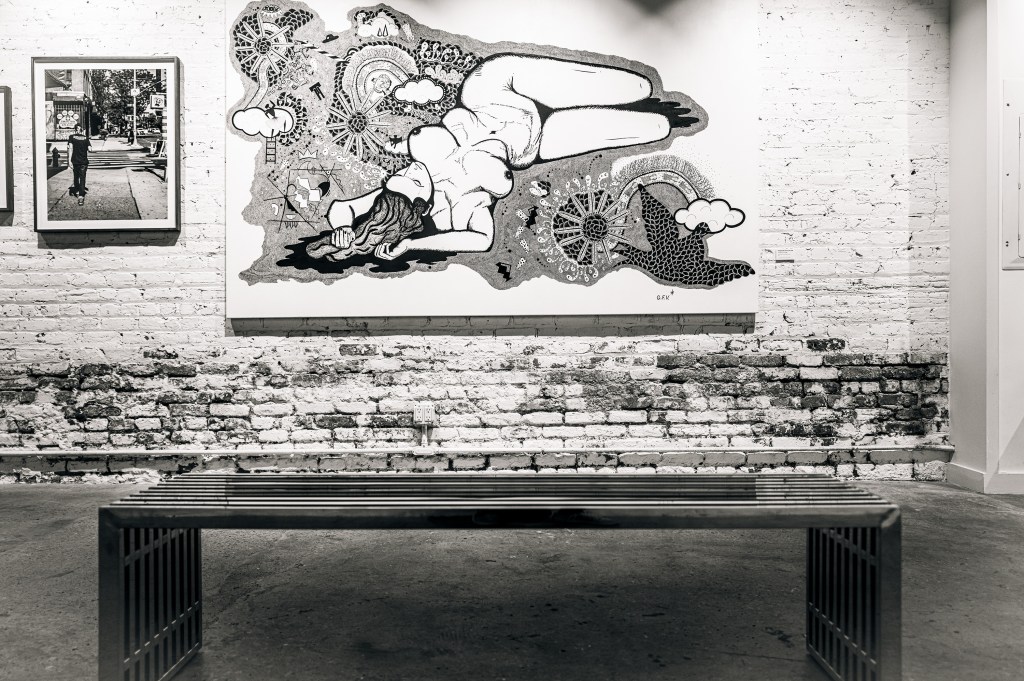
Acrylic and Ink on Canvas, 116 x 70”, 2023
In your tribute to Joséphine Baker, you erase the details of her face. Why?
I started from a sketch by a little-known Montmartre artist, included in her memoirs. It was just a single charcoal line. She appeared as an impression, almost like a logo. In the drawing, she was turning her head. You could recognize her hairstyle, an eyelash, an eye.
I added a tattoo because, to me, she has something very virile, and of course there is the reference to the 1920s, which I love, and to Montmartre as a whole.
The Sleeper in the Valley, by contrast, is dense with detail and deeply engaged.
Yes. For me, it is a punch-in-the-gut work. I created it in the aftermath of the events of October 7 in Israel, and in response to the crimes committed against women, young girls, and families. It speaks to the universality of war as experienced by women—whether in Somalia, Ukraine, Israel, or Palestine.

Catching a dream also means being able to see dreams as they pass by. Dreams disappear when we wake up. But in your case, it feels more like being present while awake, ready to catch those dreams.
We can also reverse the perspective. We tell ourselves that we realize our dreams, that we live them, and yet sometimes my dreams look more like nightmares or almost like reality.
Is reality a nightmare?
Sometimes it is the opposite. In my dreams, I see things that can be terrifying, suspended between dimensions. And when I wake up, with the Alphabet Studio, I live my dream. I realize it. The logic is almost reversed. I often think of Salvador Dalí, who worked with Edison’s method. He would fall asleep holding a silver ball in his hand. When the ball fell, it woke him in that in-between moment, where his most powerful creative ideas emerged. It is that space between light and deep sleep that interests me.
And I have the feeling that when we welcomed our friends to the Alphabet Studio for the opening, they were able to step into a dreamed space. A space that allowed them either to engage with reality or to step away from it, and give themselves over to whatever they wished: a conversation, an encounter, an affectionate glance.
That is the mission of the Alphabet Studio. It is meant to be a magical portal. When people walk through the door, they all carry daily suffering, sadness, worries made heavier by wars, social media, and an exhausting world. I want people, when they arrive, to think: I am with my own people. I am safe here. For me, the door of the Alphabet Studio should open onto that feeling: a sanctuary where we can share culture, celebrations, friendship, and conversation.
Dreamcatchers, on view until February 28th, 2026
The Alphabet Studio
743 6th Street in Manhattan
By appointment: rjones@live.fr
https://gwendolinefinazdevillaine.com/

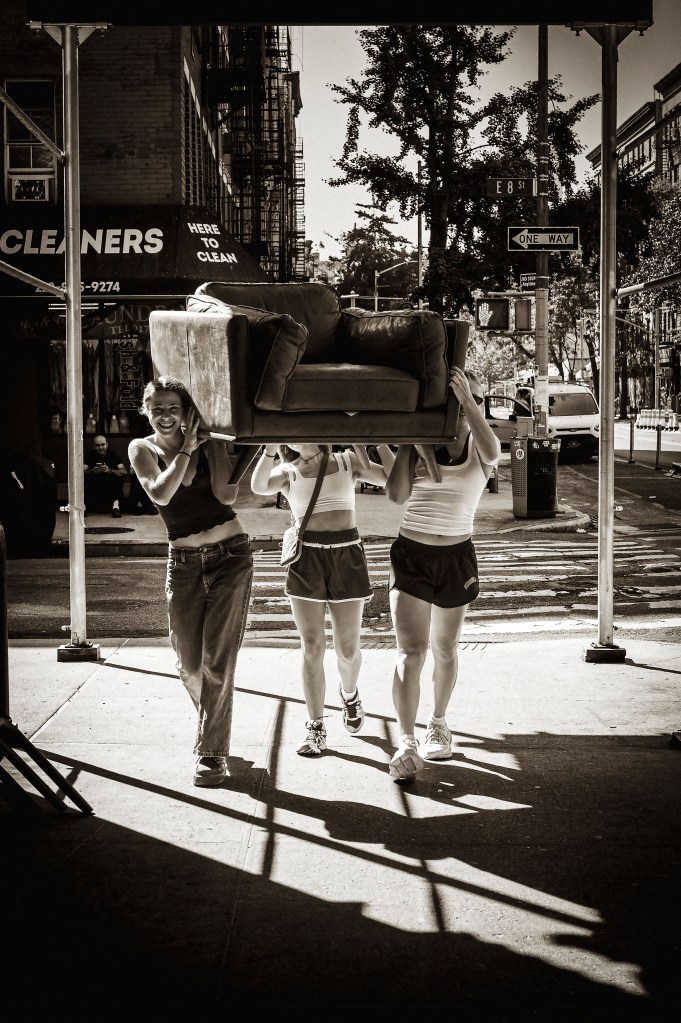
on view at Alphabet Studio until February 28th, 2026