

A conversation with Marianne “Yayane” Verbuyt, teacher, explorer and dot-connector. To learn more, donate, and join the Friends of Pokhare, Click Here.
You cannot live a perfect day without doing something for someone who will never be able to repay you.
Lewis Katz, quoting American basketball coach John Wooden at Temple University Commencement Speech. May 15th, 2014
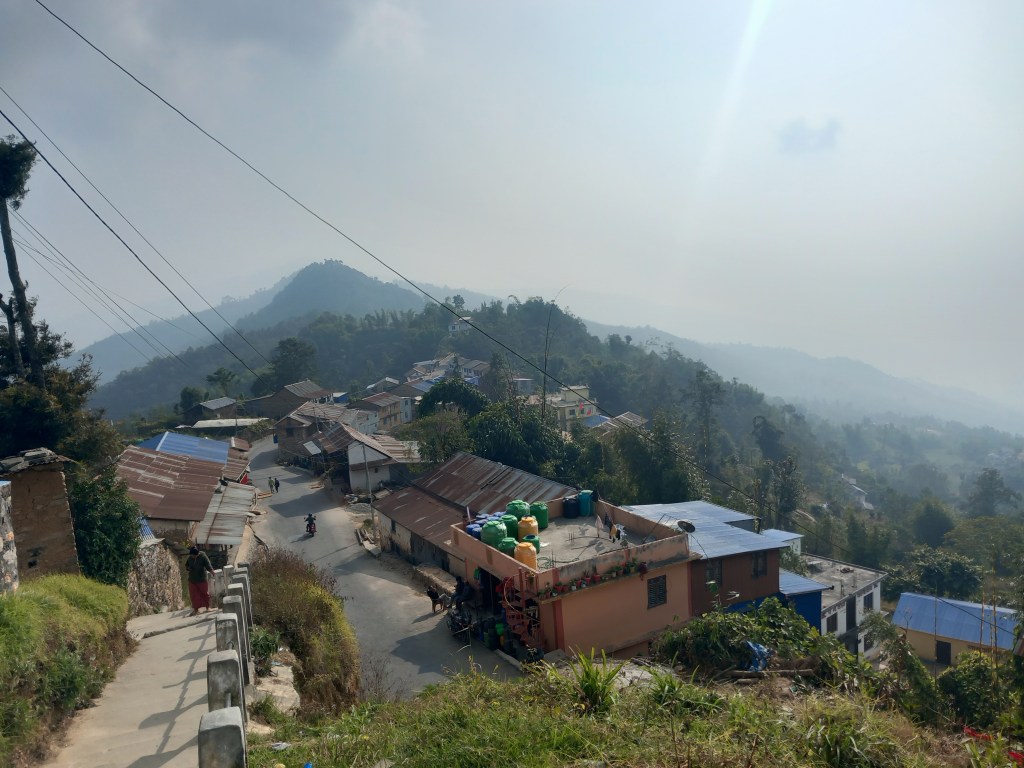
There is a village in Nepal named Pokhare, tucked in the foothills of the Himalayas—between Kathmandu, Mount Everest, China, and India. Pokhare’s community is so remote and rural that the nearest school is two-and-a-half hours away. Locals farm cardamom and oranges. Barely half the adult population is literate, and many don’t even speak Nepali, the national language.
“We need to build a school for this community,” Philippe and Carole Delouvrier told me. They are close friends—discreet yet committed supporters of education, scientific research, and culture. Philippe sits on the board of United World Schools USA, a nonprofit originally founded in London nearly 20 years ago to bring education to places where there is none.
“Would you lead the fundraising effort for this project?” they asked.
What they meant was: Would I commit to coordinating a $115,000 fundraising campaign over six years, so United World Schools could build an eight-classroom school in Pokhare? The school would include gender-split toilets, handwashing stations, and, in its first year, welcome 75 children taught by 10 trained teachers.
UNESCO estimates that 250 million children around the world are out of school.
This one school in Pokhare will reach just 75 the first year. Seventy-five out of 250 million. Is that enough to claim we are making a difference?

United World Schools thinks so—and they have evidence to back it up. Since its inception, the organization has built over 300 schools in remote areas of Cambodia, Myanmar, Madagascar, and Nepal. It has trained 1,500 teachers and enrolled more than 75,000 students.
Still, I wanted to be sure. While I would always say yes to Philippe and Carole, I called Marianne Verbuyt—better known as Yayane. A seasoned private teacher and expert in education and psychology, she is also a francophone at heart, once featured in a French documentary for her work with twin sisters born prematurely and believed incapable of learning to read, write, or count.
I asked Yayane what she thought.
Her response was swift and clear. There are too many children in the world who are left behind, she said—without access to basic education or adult protection. “I will co-pilot this project with you,” she added.
With our partnership in place, we turned to Francesca Lanning, director of United World Schools USA, for deeper context. She explained that Pokhare is home to the Rai and Limbu people, indigenous communities with deep-rooted ties to the land. They are farmers. Some families with means send their children to distant city schools. But for the poorest, there is nothing.
Worse than nothing, in fact: no road access, limited clean drinking water, no healthcare, and virtually no educational infrastructure.
Nepal has struggled. Between 1996 and 2006, a decade-long civil war claimed 17,000 lives and deepened poverty and inequality. Then, just as a democratic dawn was rising, disaster struck again. In April 2015, a massive earthquake shook the country. An avalanche buried Mount Everest base camp, killing 22 mountaineers and Sherpas. Countrywide, nearly 9,000 people died that day, and the earthquake left hundreds of thousands homeless. Entire villages were flattened, and schools, naturally, took a devastating hit. According to United World Schools, the earthquake destroyed 32,000 classrooms and 9,000 schools.
Clearly, much remains to be done. The need to share some of our wealth and privilege with children we may never meet has never felt more urgent.
Still, I asked Yayane one more question: ‘Why should we try to make an impact in a place neither of us has ever seen—a world so far from our own?’
She smiled.

Giving without expecting thanks or acclaim in return, that is true giving. Giving for something invisible and immeasurable, where we remain in the shadows.
Yayane Verbuyt
JC Agid: Isn’t it a bit idealistic—and maybe even against all odds—to support the creation of a school far from everything in Nepal, nearly a 12-hour drive from Kathmandu and from Mount Everest Base Camp? In other words, on the other side of the planet from New York. Why did you want to pilot this project with me?
Yayane Verbuyt: First of all, I have a deep love for India, Nepal, and this part of the world. Every time I have traveled in these regions, I have encountered smiles and smiles and smiles again from people who had almost nothing. Where did those smiles come from? Probably from something deeply rooted within them. It made me want to give back.
In this case, giving back means creating a group of friends who will finance this school, a world apart from theirs. You, the teacher, become—de facto—the co-creator of a school that you won’t even be running.
I have been working in education for a long time, but never from a place of hierarchical authority, even though I teach. I have always said that my students are also my teachers because you can intuitively understand what they need by observing them.
With so much knowledge available everywhere, what do you think they need most?
Today, students can access knowledge through artificial intelligence and a multitude of applications, as diverse as they are unexpected.
When all knowledge comes from outside, in an automated way, I see young people in the making who are full of doubts—because they place the machine above themselves. However, the machine should remain a tool that serves humanity, not the other way around.
The role of the teacher is evolving. Of course, they remain a holder of knowledge, but above all, they become a person who accompanies another human being in their development. They help students identify the tools best suited to their learning and guide them in understanding the methods they need to master—so they can gain confidence and build their knowledge through dialogue, listening, and exchange. These are essential skills for engaging with tomorrow’s world.
The school in Pokhare, currently under construction, is in a very remote, hilly area. It’s not even sure that internet access will be available there. In its first year, the school will welcome 75 students. Is that enough to make an impact?
As human beings, we are all responsible for one another. I have always believed in the butterfly effect. Those 75 children may each talk to two or three others, and so on. One person can influence thirty-five.
If we can offer 75 children the chance to escape a predetermined fate and discover the first keys to reading and writing—then maybe they will become the authors of their own lives.
Right now, their geographic, economic, and political context dominates them.
There is an urgent need to act. So yes, I am committed.
Knowing how to read, write, and count is the essential building blocks for becoming a member of society. However, the essence of knowledge also comes through dialogue.
Yayane Verbuyt


We will probably never meet them. We will not form bonds with them; we will not do business with them. We will not even bask in their gratitude. Is this a useless gift, or worse, hypocritical?
It is a question I have often asked myself: do we give for others, or for ourselves? Do we provide to be acknowledged, to welcome a thank you, and ultimately to flatter our egos? Precisely, giving without expecting thanks or acclaim in return, that is true giving. Giving for something invisible and immeasurable, where we remain in the shadows.
And yet, even schools in cities like New York need support. So why choose to act on the other side of the world?
First and foremost, it is about saving children —protecting them from things that should no longer exist in the 21st century: lack of hygiene, human trafficking, slavery, the prostitution of young girls, and violence against children—all still too prevalent in certain parts of the world.
These children are also vulnerable to political manipulation. Without the power of discernment, without the ability to read and write, and without the tools to learn and think, they become vulnerable targets for ideological rhetoric—whether political or religious.
These schools offer not only safety and health protection, but also an economic alternative and a breath of openness. In the long run, they give these children a political voice—one just as important as ours.
Education, in this context, is powerful. It acts as a bulwark against any totalitarian threat.
Exactly. Every authoritarian regime seeks to take control of education to suppress freedom of thought. History shows us this clearly through book burnings—acts like the auto-da-fé have always been about domination.
Without the power of discernment, without the ability to read and write, and without the tools to learn and think, they become vulnerable targets for ideological rhetoric—whether political or religious.
Yayane Verbuyt
What kind of knowledge should every human being have access to today?
Knowing how to read, write, and count is the essential building blocks for becoming a member of society.
But how can we teach in villages where access to technology and economic resources are not at the same level as in developed countries?
The essence of knowledge also comes through dialogue.
We must invite—and even encourage—young people to engage in debate. Ask them: ‘What does it mean to debate’? Show them that people can think differently, think for themselves, defend ideas, and disagree without hating each other.
Education should not be reduced to a simple program to be applied. The curriculum is essential, of course—just like learning the basic steps in a ballet. But then you need the choreographer. The one who says: ‘Here’s the subject. How do you imagine it? How do you understand it?’
That’s what it means to educate children to become thinking human beings—not just blindly obedient ones.
If you could spend a week in Pokhare, what would you do?
The first thing I would do is respect their culture. I would observe one or two classes, and of course, I would take in the incredible value of this infrastructure and its teachers. Then, I would offer to engage in a shared lesson—perhaps on a math problem, a text analysis, or a topic in history or geography. I would say to them:
‘I’m going to make you smile—how do you think this would be taught in the country I come from?’
Then, I would take the same subject and teach it through my own cultural lens—because cultural predetermination is just that: a perspective. It is not a universal truth. And I would tell them:
‘Look, where I come from, we teach that in this way. And where you come from, it is taught differently. I might not be right—and maybe neither are you. But we have two different points of view. What if we talked about them together?’
This comparison of ways of thinking—shaped by culture, history, and language (because language structures the mind)—fascinates me. Understanding that is the first step to thinking together without imposing.
What mistake should Americans and Europeans avoid when building and running schools in remote regions of Asia or Africa, as United World Schools does?
The challenge is not to repeat the mistakes of history. Colonial schools often sought to impose outside knowledge. Here, it is the opposite—it is not about evangelizing but opening. It is about respecting who they are while offering them a window to the world.
How would you do it?
The greatest gift would be to offer them comparative teaching experiences. Imagine they host a history and geography teacher from Switzerland or Alabama for a week. That teacher could speak about India or Nepal. This would naturally lead to a discussion on how someone from the outside sees and presents their own country—or that of their neighbors.
Now imagine telling children in an Indian school that they should not use plastic bottles or straws—when, for them, a plastic bag is useful and versatile: They wash it and reuse it. It is not something you throw away. That bag can represent something beautiful.
We are not going to approach ecology with the same voice. The challenge is always to bring different perspectives together—not to make them all the same.
Isn’t that a bit utopian? One world, but as many prisms as there are perspectives.
That is precisely what we need. Today, we no longer have intersecting points of view. We have built an economic globalization where everyone wants the same sneakers, the same branded jeans, or a fake T-shirt with some iconic logo.
A gentrified world where everyone looks the same. So, should schools break this uniformity of perspective?
We have forgotten to teach that we all think differently because of our predetermination. And that this is a source of richness.
Whenever we teach something, it is essential to remember that we are doing it from within our own story, from a particular point of view. That perspective is neither universal nor an absolute truth.
The day we accept that each cultural lens is as valuable as any other —and the day we can talk about even the simplest questions, whether philosophical, mathematical, or historical, while recognizing our own biases—that is the day we will truly be able to have a conversation…
… and laugh together, with the girls and boys of Pokhare, at our differences—inside a school built for them.
To learn more about this project,
donate and join the Friends of Pokhare:
click here
A major thank you to the first friends of Pokhare: Nadia Afridi, Isabelle Aime, Amira & Dean Amro, Michèle & Marc Atlan, Nefissa & Christophe Attard, Martine & Prosper Assouline, Véronique Barbey, Inma Barrero & ion Yadigaroglu, Paige Boller, The Connelly Foundation, Sophie & Dahlia de Lavendeyra, Isabelle Delouvrier, Carole & Philippe Delouvrier, Gwendoline & Charles Finaz de Villaine, Corinne Fingeret, Marie de Foucaud, Aurélie Gabriele, Anne-Sophie Gueguen, Nicolas Guillant, David & Karine Jones, Sharzhad Khayami, Kristen Kosmos, Nannette LaFond-Dufour, Francesca Lanning, Harper Georgina Ogilvie Mourlot, Isabelle Peeters, Nathalie Regnault, Fadwa Robb, Yayane Verbuyt, Alexander & Ashley Von Perfall, Elitsa Savouyaud, Helena Skarstedt, Olga & Frédéric Rozé, Charly Tolède, Maïlys Vranken, Catherine Weinberg, and Lisa Woodward.

यो पढ्नु भएकोमा हार्दिक धन्यवाद।
(Thank you for your reading)

Leave a Reply