

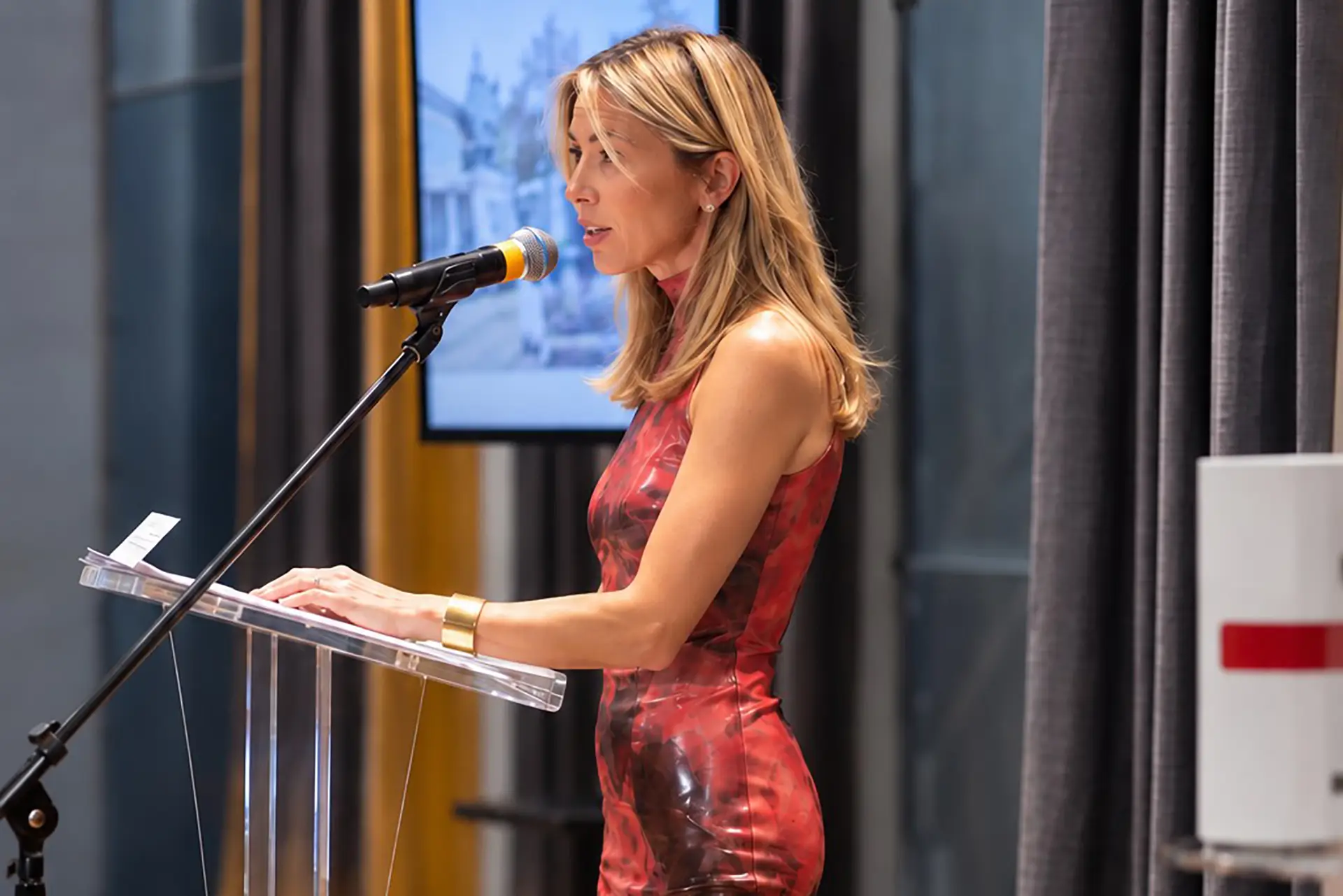
Laetitia de Cayeux was awarded the Anne Morgan Women of Courage Award by the American Friends of Blérancourt on October 26, 2026. Quotes are excerpts from her acceptance speech.
About American Friends of Blérancourt, click here
When my friend Laetitia de Cayeux, a Franco-American frontier-technology entrepreneur and investor, accepted the 2026 Anne Morgan Women of Courage Award in New York on Oct. 26, she explained that courage is not only about what we endure, but also about what we choose to make possible.
“Courage lives in each of us,” Laetitia de Cayeux told the American Friends of the Franco-American Museum of Blérancourt at Villa Albertine. “But the permission to dream is something we build together,” she added.
What I find really inspiring about Laetitia is her determination to pursue ideas that others might consider impossible. She works to make them real. And that takes courage.
Maye Musk
It takes the permission to dream to turn that courage into action.
So, was it courage that drove Anne Morgan, daughter of the American financier John Pierpont Morgan, to cross the Atlantic in 1917 and settle in Blérancourt, a small village in Picardy, north of Paris, close to the front, while World War I raged and left behind ruins and bodies?
Or was it a permission to dream that she could help? Help heal the wounded. Help feed them. Help rebuild their houses. Help grow vegetables again. Help them open books and study, so that they too could dream of peace and prosperity.
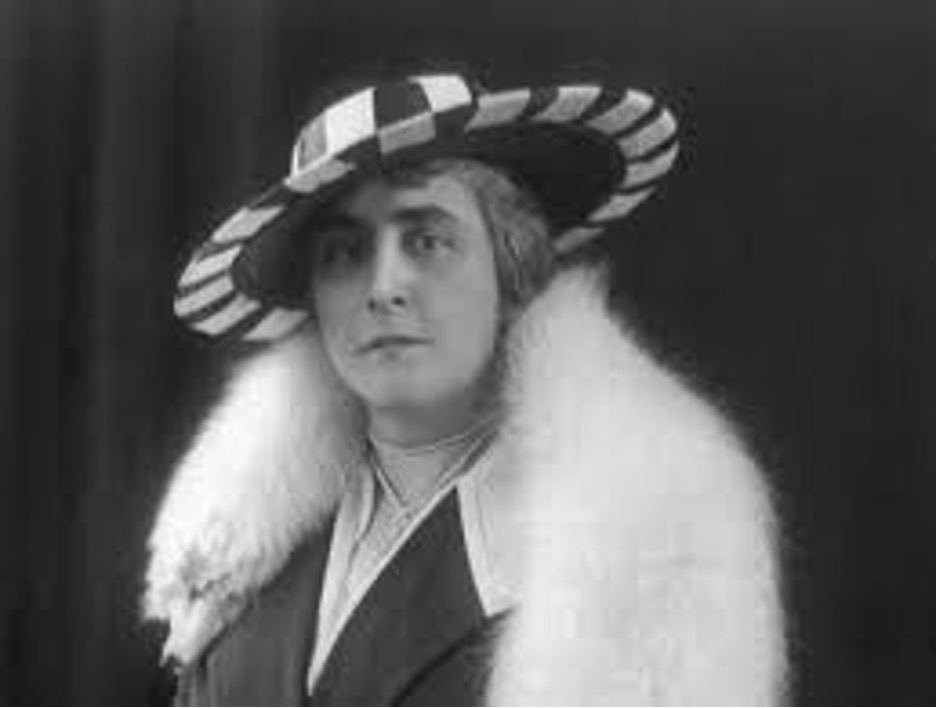
Anne Morgan was one of the great women philanthropists of her time. In 1903, at age 30, she co-founded the Colony Club, one of New York City’s first private clubs created by women, for women. She went on to support women workers in the garment district, while her father devoted his career to the conservative financial interests of the Gilded Age.
Anne Morgan never dreamed entirely alone. The French army entrusted her with the ruined Château de Blérancourt as a base for the cohort of American women volunteers who joined her to create the American Committee for Devastated France.
The American Friends of Blérancourt created the Anne Morgan Women of Courage Award in 2018 to carry her name forward. Actress Rita Wilson was its first recipient. Philanthropist Hélène David-Weill and Judith Pisar, a builder of cultural bridges between the United States and France, were among the ones who followed, then Ambassador Melanne Verveer and designer Tory Burch.
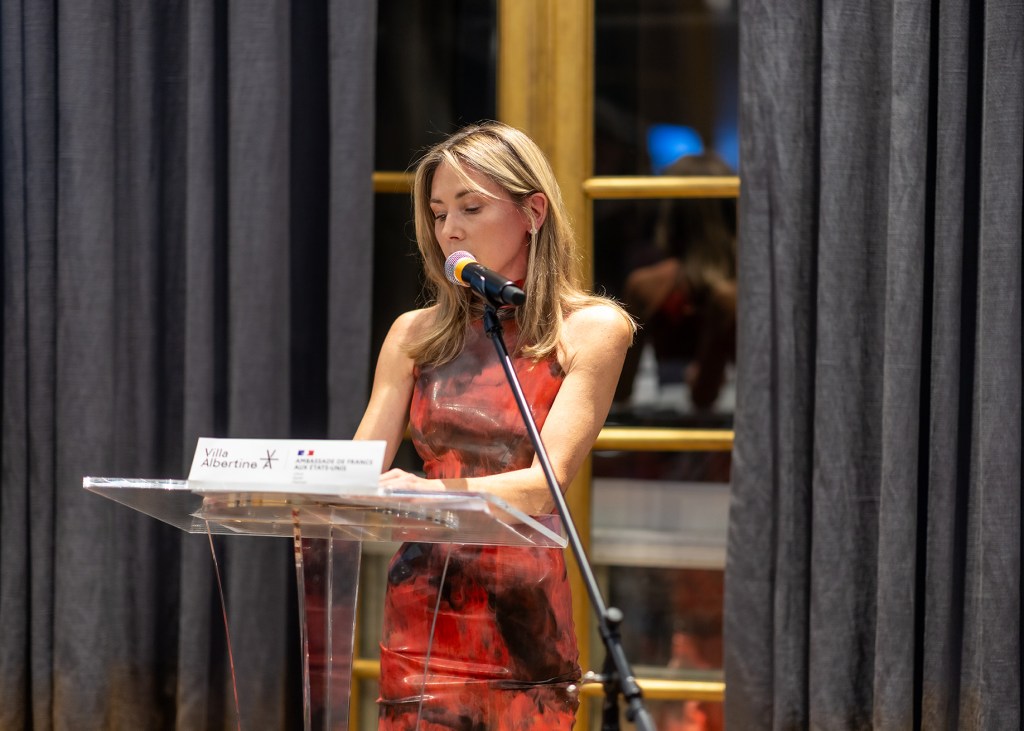
“What I find really inspiring about Laetitia is her determination to pursue ideas that others might consider impossible. She works to make them real. And that takes courage,” said model, dietitian and author Maye Musk who introduced Laetitia de Cayeux at the award ceremony.
Maye Musk recalled meeting Laetitia de Cayeux a decade ago at Elon’s home, following the Tesla Model 3 unveiling.
“You raised children who dreamed about what they wanted to create in this world, and then went and built it,” Laetitia de Cayeux replied.
Maye Musk, whose new book Timeless is about reinvention at any age, knows something about permission to dream. She is the mother of three entrepreneurial children: Elon, of course, with Tesla, SpaceX, Neuralink and Starlink, among others; Kimbal, a restaurateur and entrepreneur; and Tosca, the filmmaker, founder of Passionflix.


With a grandfather on the Moon, I never had much hope of escaping moonshots. But a moonshot is more than going to the Moon. A moonshot is deciding that something worth doing is possible before you have any evidence that it will work.
Laetitia de Cayeux
Accepting the award in Anne Morgan’s memory, in the ballroom of the Payne Whitney Mansion on Fifth Avenue, an architectural symbol of New York’s Gilded Age and home to France’s Villa Albertine, Laetitia de Cayeux reminded everyone: “In 1917, Anne Morgan did not go to a dinner about Blérancourt. She went to Blérancourt. A village within range of the guns, which most people were trying to leave. She understood something that is easy to forget. Seeing what needs to be done is not courage. Going is.”
If Anne Morgan crossed the Atlantic eastbound, Laetitia de Cayeux flew to America westbound.
In 1986, when Laetitia was 8 years old, her mother died by suicide and she lost her grandfather that same year. It was, she said, before the internet, and before children had screens. “I had a great deal of time to be bored, and to think. And for reasons I still do not entirely understand, my eight-year-old way of making sense of it was to calculate the probability. What were the odds that a little girl would lose her mother and her grandfather in the same year?”
The question stayed with Laetitia. Years later, she discovered the mathematical concept that gave form to what she had intuitively understood as a child: the tail of a probability distribution. “Extraordinarily unlikely things happen”, as she put it. Sometimes they are terrible.”
“It took me much longer to understand the second half of the lesson,” Laetitia de Cayeux told us. “The tails exist in both directions. Extraordinarily unlikely good things happen too. And unlike the terrible ones, we can choose to pursue them.”
As an adolescent, Laetitia found inspiration in the legacy of her late grandfather. His name was André de Cayeux de Senarpont, and he published as André Cailleux. He was a geologist, and his eyes were turned toward the sky and the light of the myriad stars all around.
“In 1948 he began doing something that sounded, at the time, faintly ridiculous,” Laetitia de Cayeux said. “He took the science of rocks and landscapes, the science of this planet, and applied it to the Moon and to Mars. Worlds nobody had visited. 1948 was nine years before Sputnik. It was twelve years before the United States created the field of planetary geology and gave it a name.”
“Twelve years is a long time to work on something that does not yet have a name. Nobody gives you an award for that. I have come to believe it is the most common kind of courage there is, and the least visible.”
A decade after her grandfather’s death, a crater on the far side of the Moon, the side never visible from Earth, was named after him.
“It was not pride I felt. It was closer to permission. It made me wonder how much of what looks impossible is simply early.”
“With a grandfather on the Moon, I never had much hope of escaping moonshots. But a moonshot is more than going to the Moon. A moonshot is deciding that something worth doing is possible before you have any evidence that it will work. What is the world you want to exist? And what are you prepared to do to make it a little more likely? Over the years, my answers to that question have come in three forms.”
- Preserving Life
- Building what does not yet exist:
- Transmitting knowledge


We do not choose where we come from, or everything that happens to us. But we choose what we build. And what we make possible for those who follow.
Laetitia de Cayeux
The first form, she explained, is to look for ways “to preserve a chance at something that will matter for a whole life, whether it is one life or many.”
So Laetitia de Cayeux helped build a company dedicated to preserving women’s fertility, including young women facing cancer, preserve their fertility, so that the illness would not take away their chance of becoming mothers one day, if they wished.
The Franco-American entrepreneur later served on the Defense Science Board at the Pentagon. “A very different world, and the same idea at a different scale: preserving a chance at peace, for a great many lives at once.”
The second form is “to build what does not yet exist, and discover what we do not yet know.”
Today, that idea drives Global Space Ventures, the firm she founded and leads, which backs pioneers of frontier technology.
She was an early investor in SpaceX, “when the reasonable view was that rockets are what governments do.”
She also co-founded a company developing high-power microwave propulsion systems, “because reusable rockets are the holy grail of spaceflight, and I wanted to help make sure humanity got there.”
And she began working on cell towers in space “when it was a napkin sketch, but a sketch I could see would let anyone, anywhere, reach someone in a moment of need, and open possibilities for everyone on Earth.”
It is no surprise, then, to find Laetitia de Cayeux on the board of XPRIZE, which celebrates the impossible becoming possible.
The third form is transmission.
“At the National Museum of Mathematics, I think about my eight-year-old self calculating probability to make an unbearable year make sense, and about children, and especially girls, discovering that mathematics is not a subject they are bad at. It is a way of seeing.”
Laetitia de Cayeux has also written a series of fables set on Mars, to be published by Assouline. The stories began for her two children, Kinga and Ronin, but the books took so long that the children grew up, “so the fables will have to be for everyone else’s children too.”
“They are not lessons about being brave. They are stories about setting out without knowing how things will end. Because you cannot instruct a child to be courageous. You can only show them, again and again, people who went anyway.”
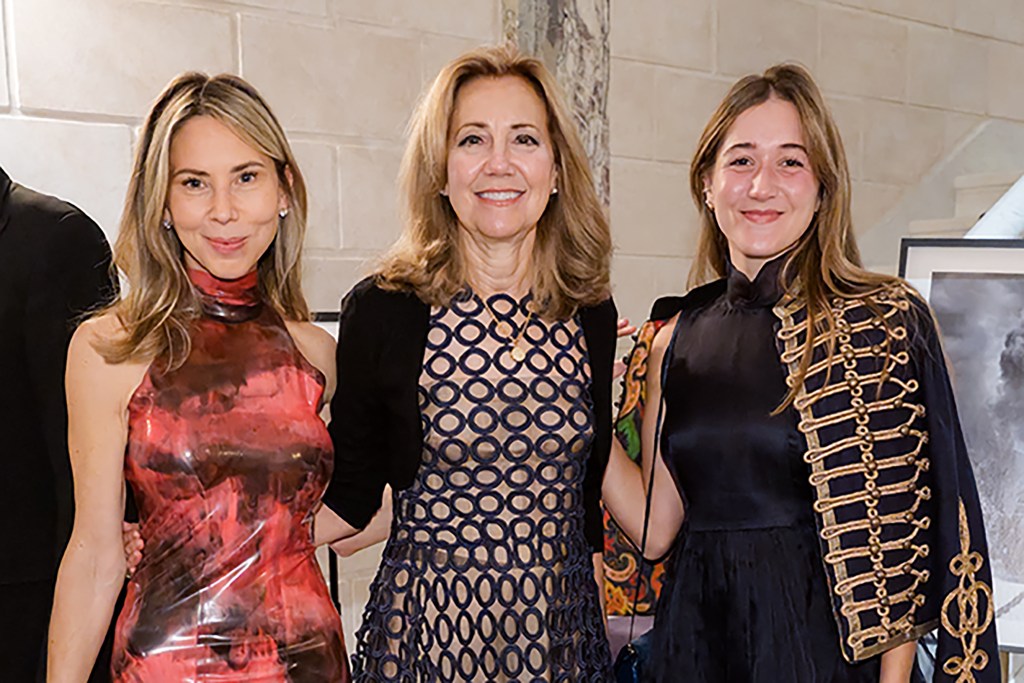
(c) Annie Watt for American Friends of Blérancourt
A permission to dream, then. Not an order to be courageous.
“For my children … and for every child finding their way—my hope is this: You will not choose everything that happens to you. Nobody does. But you will choose what you build. I hope you find questions you love enough to chase, and people you love chasing them with. You do not have to know yet what those dreams are. You only have to keep going.”
France, Laetitia de Cayeux said, gave her its foundations: a school that offered a grieving child somewhere else to put her mind, and teachers who took her questions seriously.
“That is what a country owes its children. Not to choose their dreams for them. To show them the dreams are allowed,” she said.
America, she said, gave her the other half: an invitation to become a pioneer, “an extraordinary permission to attempt. To build. To fail. To try again.”
Laetitia de Cayeux is, in her own words, “deeply French, and profoundly grateful and proud to be American.”
Anne Morgan, too, lived under this transatlantic umbrella. She gave the Château de Blérancourt to France, where it became a national museum in 1931, keeping alive the memory of a friendship between the United States and France that Lafayette helped forge. In 1932, France made her a Commander of the Legion of Honor, the first American woman to receive that rank.
“We do not choose where we come from, or everything that happens to us. But we choose what we build. And what we make possible for those who follow,” Laetitia de Cayeux concluded. “Anne Morgan did. And that, to me, is courage.”
Or more than courage: the permission to dream became the force to act.


All pictures in this post with the exception of the picture of Anne Morgan (c) Annie Watt for American Friends of Blérancourt
Leave a Reply