The Power of Words to Empower Women

To Power of Words to Empower Women: Five questions to poet Amanda Gorman


Amanda Gorman looks a bit younger than her age of 22 says, and at 22, the Los Angeles born activist has already reached heights that very few people have. A Harvard University student, she made her way as a Youth Delegate to the United Nations in 2013  after listening Pakistani survivor Malala Yousafzai speak. Her own words made her poet. She became the first National Youth Poet Laureate in 2017 and ambitions to run for President in the United States sometimes.


A young poet? Think again. Arthur Rimbaud was a teenager when he composed some of his most famous poems.


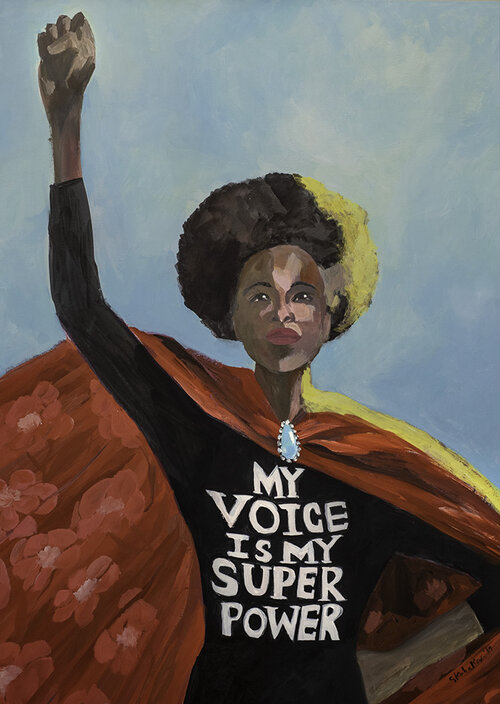
Gorman is a poet, an activist and a social entrepreneur. Period. She is a leader whose voice is already vital. She created a youth writing program, read poetry on MTV and at the Library of Congress, and she just authored the foreword of  Vital Voices: 100 Women Using Their Power to Empower (Assouline). No wonder her portrait, created by Gayle Kabaker, made the cover of a book that includes Senator Hillary Rodham Clinton, New Zealand Prime Minister Jacinda Ardern, European Central Bank President Christine Lagarde, Fashion Designer Diane Von Furstenberg, and Supreme Court Justice Ruth Bader Ginsburg.


No surprise either: her foreword is a poem. It is about words after all, and sharing them.


Published by Assouline (www.assouline.com) – Cover (c) Gayle Kabaker

What is the power of words to change the paradigm on women in the world?
Words are everything and everywhere. They enable us to model the types of leadership and change we hope to see in our communities. For example, in general I tend to notice women leaders more so using a rhetoric of hope, compassion, and fairness. That type of language not only restructures how we think about women leaders, and all the gifts they bring to the table, but also leadership in general, which should be unafraid of empathy and generosity.

Is today’s youth ready to become tomorrow’s change makers?
I’d say today’s youth are already the change-makers of both today and tomorrow! I think with the movements we see spearheaded by youth–the climate crisis movement, the March for Our Lives, and certain parts of Black Lives Matter–they are inherently improved by this generation’s relentless energy and historical understanding. They come with a deep knowledge of our shortcomings of the past, particularly as it relates to the previous exclusivity of social leadership, and have no intention of repeating them.

Part of your work involves visiting schools. What do you tell students? How do they react? What do they ask? 
As a poet I visit several schools across the country, and it’s always one of the most rewarding aspects of my work. I usually talk about my life, my career, my writing, and the importance of recognizing poetry as an art that isn’t the private property of dead white men. I think they’re often shocked to hear what I’ve been able to do with our writing, because I’m quite young like them, and look younger than I am. So on that note they often ask about my age (some have even thought I’m in 7th grade; I’m 22), and advice I have for them. I also think there’s this excited understanding of how malleable and democratic poetry can be, if we let it. 

Are the media making enough room so that women’s voices are heard?
No, not at all. I mean one data point you can see quite starkly in the serious dearth of women late-night hosts, a digital venue which is more so becoming the arena where many access information about the news. But, beyond that, so much of the media is men discussing men. I do think we’re making some more headway in that space, and it is invigorating to see women creating their own forms of media and messaging to spread their voices, projects much like this one!

One of the point you make is about the power to empower. Is that what feminism should be all about? 
Definitely. Feminism, and in particular intersectional feminism (as well as black feminism, which I study), is all about breaking our chains collectively, that none of us are free until all of us are. I believe in that on both a spiritual and pragmatic level. It’s not only morally right, but strategically sound; I can only unlock my sister’s shackles if I break my own. And I can only break my own with another ally beside me, helping me slot in the key.


Amanda Gorman
is the author of The One for Whom Food Is Not Enough.

To learn more about Amanda Gorman: http://www.amandascgorman.com/home.html

IG: @amandascgorman

More about Gayle Kabaker’s illustrations: http://gkabaker.com

Vital Voices: 100 Women Using Their Power to Empower published by ASSOULINEhttp://www.assouline.com


Amanda Gorman (c) Kayle Kabaker

3 responses to “The Power of Words to Empower Women”

  1. […] of leadership and change we hope to see in our communities,” says 22-year-old poet Amanda Gorman, author of the Vital Voices’ book foreword. “I tend to notice women leaders more using a […]

  2. […] au changement que nous espérons voir dans nos communautés, » explique la poétesse de 22 ans Amanda Gorman, auteur de la préface du livre de Vital Voices. « Je remarque que les femmes dirigeantes […]

  3. […] the types of leadership and change we hope to see in our communities,” notes 22-year-old poet Amanda Gorman, who wrote the foreword for the Vital Voices’ book. “I tend to notice women leaders more using […]

Leave a Reply

Discover more from 37East

Subscribe now to keep reading and get access to the full archive.

Continue reading