

Next July 12, 2026: Unveiling of Monumental Jeu de l’Oie
during L’Alliance New York’s Bastille Day
from noon to 5:00 p.m. on Madison Avenue and 60th Street.
A conversation with artist Pauline Lévêque
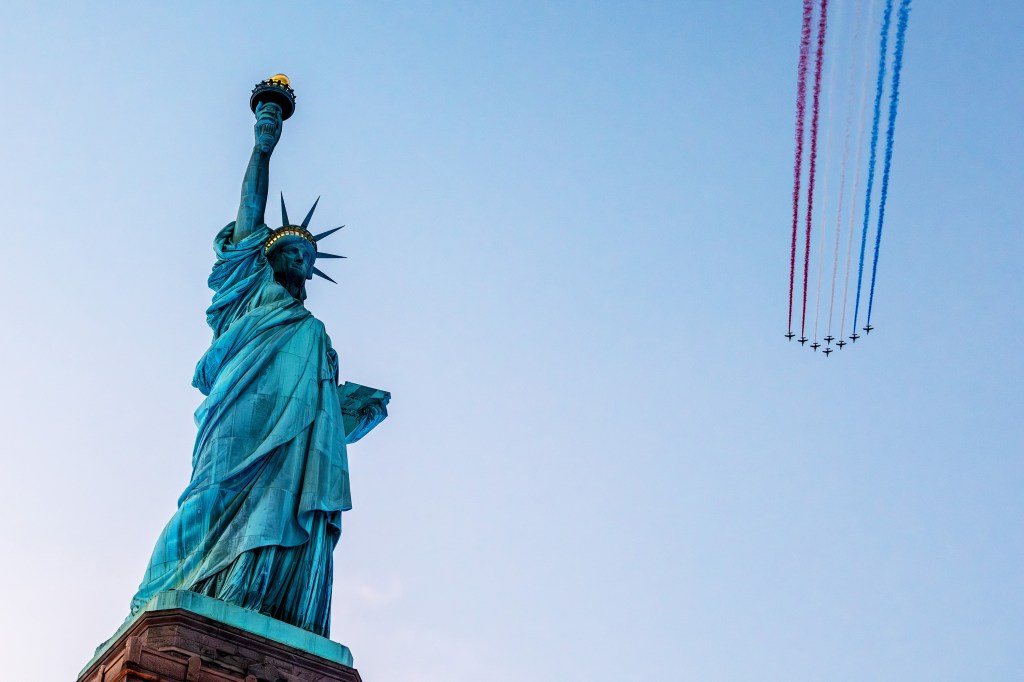
It seems that Paris and New York have always shared a romantic affair. Two cities with opposite styles, cultures and souls, attracted to one another as lovers are. A relationship sealed with Bartholdi and Eiffel’s sculpture, France’s gift to celebrate the Independence of America: the Statue of Liberty.
This year, the affair gets a new love letter in the form of a giant street art installation.
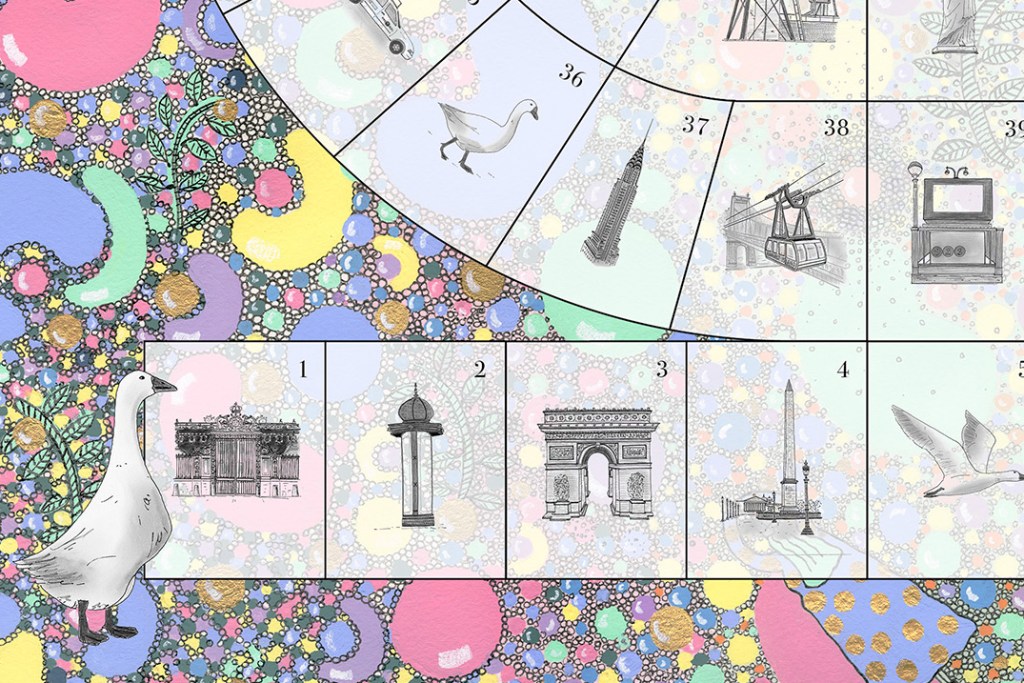
On Sunday, July 12, 2026, Madison Avenue between 59th and 60th street will disappear under an enormous board game. The Monumental Jeu de l’Oie, a participatory public artwork by visual artist Gwendoline Finaz de Villaine and illustrator Pauline Lévêque, will be unveiled for L’Alliance New York’s Bastille Day celebrations, nearly as large as the stretch of asphalt it covers. Sixty-three squares will run the length of the block, each one a monument or an urban object of Paris or New York, inviting passersby to become players themselves.
We wanted to celebrate the 250th anniversary of American independence with the Monumental Jeu de L’Oie, so we decided to pair two cities symbolic of France and the United States.
Pauline Lévêque, co-artist of Monumental Jeu de l’Oie
“Opportunity, politics and arts are the founders of the relationship between Paris and New York,” says Finaz de Villaine, who conceived the piece as a way of transforming a centuries-old French board game into a collective human experience.
Square number one is the gates of Château Versailles. Square number 63 is the Statue of Liberty. “There is no coincidence,” she explains. Versailles is where Louis XVI decided to secretly fund the American insurgents, and where, on February 6, 1778, he signed the Treaty of Amity and Commerce and the Treaty of Alliance with the United States, represented by Benjamin Franklin. The Statue of Liberty, at the other end of the game, carries the values of enlightenment that treaty set in motion: a break from tyranny, a promise of freedom reaching across the seven continents.
“Through its 63 squares, I wanted to transform the game into a poetic metaphor for democracy and freedom,” Finaz de Villaine adds. “As in life, we move forward together, encounter obstacles, help one another, and keep believing that liberty is a collective adventure.”
“L’Alliance New York invited Gwendoline Finaz de Villaine and Pauline Lévêque to unveil their street art for Bastille Day 2026, because they conceived an interactive art installation to bring New Yorkers together in a living dialogue between two cultures that have shaped one another for 250 years,” explains Tatyana Franck, President of L’Alliance New York.


For Finaz de Villaine, the piece only exists once the public steps into it. “I wanted to create an artwork that people wouldn’t simply look at, but actually step into and experience together,” she explains. “For me, public art only becomes complete when people become part of it.”
That instinct, to make art something lived rather than looked at, is also what drew Gwendoline Finaz de Villaine to Pauline Lévêque. It runs through the whole project, but it took shape square by square in the hands of the artist she invited to draw all 63 of them. Finaz de Villaine is also no stranger to public homage: her street art tribute to Josephine Baker still stands in front of the Panthéon in Paris, itself a monument to a woman who lived her own deux amours, torn between Paris and America. It’s a fitting lineage.
Lévêque, known for her Beep Beep books and for the page she now draws every week for the French weekly Paris Match, once occupied by Sempé, works from her home-atelier in Greenwich Village, a small room scattered with drawings of both cities she loves and adjacent to the small desks where her two children do their homework.
I sat down with her there and asked if she, too, had deux amours: not America and Paris like Josephine Baker, but New York and Paris.
“Gwendoline and I are both French, not necessarily Parisian, but French. And we’re both New Yorkers at heart. So, it felt obvious to travel through this piece from Paris to New York, to trace that path and move from one city to the other,” Pauline Lévêque answered.
JC Agid: How do the two cities differ from one another?
Pauline Lévêque: They have nothing to do with each other. But what I love deeply about Paris is the intricate detail of its buildings, that sense of great age. You almost see wrinkles on the façades, traces of the city marking its own history. In New York, by contrast, it’s the lines and the perspectives that inspire me most.
How did you choose the buildings or neighborhoods for your illustrations across the game’s 63 squares?
I chose the monuments that seemed most representative of Paris and New York, and also because the original Game of the Goose had specific spaces, a prison, an inn, and so on. For the prison square, I wanted an actual prison. I was already thinking about New York, so I drew the Jefferson Market Library in the West Village, which was a prison many years ago. For the inn, I used the Place des Vosges. For the rest, I reproduced the most classic, most symbolic monuments of the two cities: in New York, the Flatiron Building, the Statue of Liberty, the Empire State Building. But finding 63 universally recognized monuments adds up fast. So, I turned to still lifes to illustrate both cities as well: a brasserie, with the bistro feel that speaks to France; a basket of pastries; New York’s fire escapes; a subway entrance.
It’s a massive work. Is this the first time you’ve worked on a piece of street art?
It’s not my first project, but it’s the first time one has come to life. I once had a project that never got off the ground, covering an entire building in Midtown. That’s where the idea of something grand, something immense, but still human in scale, first took root. Not long after, I met Gwendoline, who invited me to contribute to a piece that wouldn’t hang on a wall, but rest directly on the ground.
Let’s talk about Gwendoline. How did you two meet?
Through a mutual friend, Marie de Foucaud, over a lunch that ran long. Very quickly we started talking about our current projects, and Gwendoline told me she’d love to work with me, saying, “I don’t know many women who do street art. I’d love for us to find a project together.” The next day we had coffee, and Monumental Jeu de L’Oie was born.


What was Gwendoline’s role in this project?
Gwendoline was the initiator of this work, the soul behind its conception. She’s the one who developed the idea. She came to me wanting to create something with four hands, those of two women, two artists. And it was her idea to begin with the game of the goose. It was a beautiful coincidence, a funny one too, because I love playing board games with my children, and I adore the game of the goose. That very morning, I’d been playing a round with my daughter. So, when she told me about turning the game into an art installation, I found it perfectly fitting, so French, so Parisian, so historical. Gwendoline conceived the piece, painted the background, and oversaw its production. Then she invited me to draw the 63 squares of the game.
So, the theme is Gwendoline’s as well?
Gwendoline immediately connected it to the anniversary of American independence. She wanted the work to reflect Franco-American friendship, and the values of independence and liberty that the events of 1776 carry. So, we started the game part of the artwork at Versailles.
Versailles, and the court of Louis XVI, which sent money to the insurgents from the very start with Rochambeau, while Lafayette set sail to fight alongside Washington.
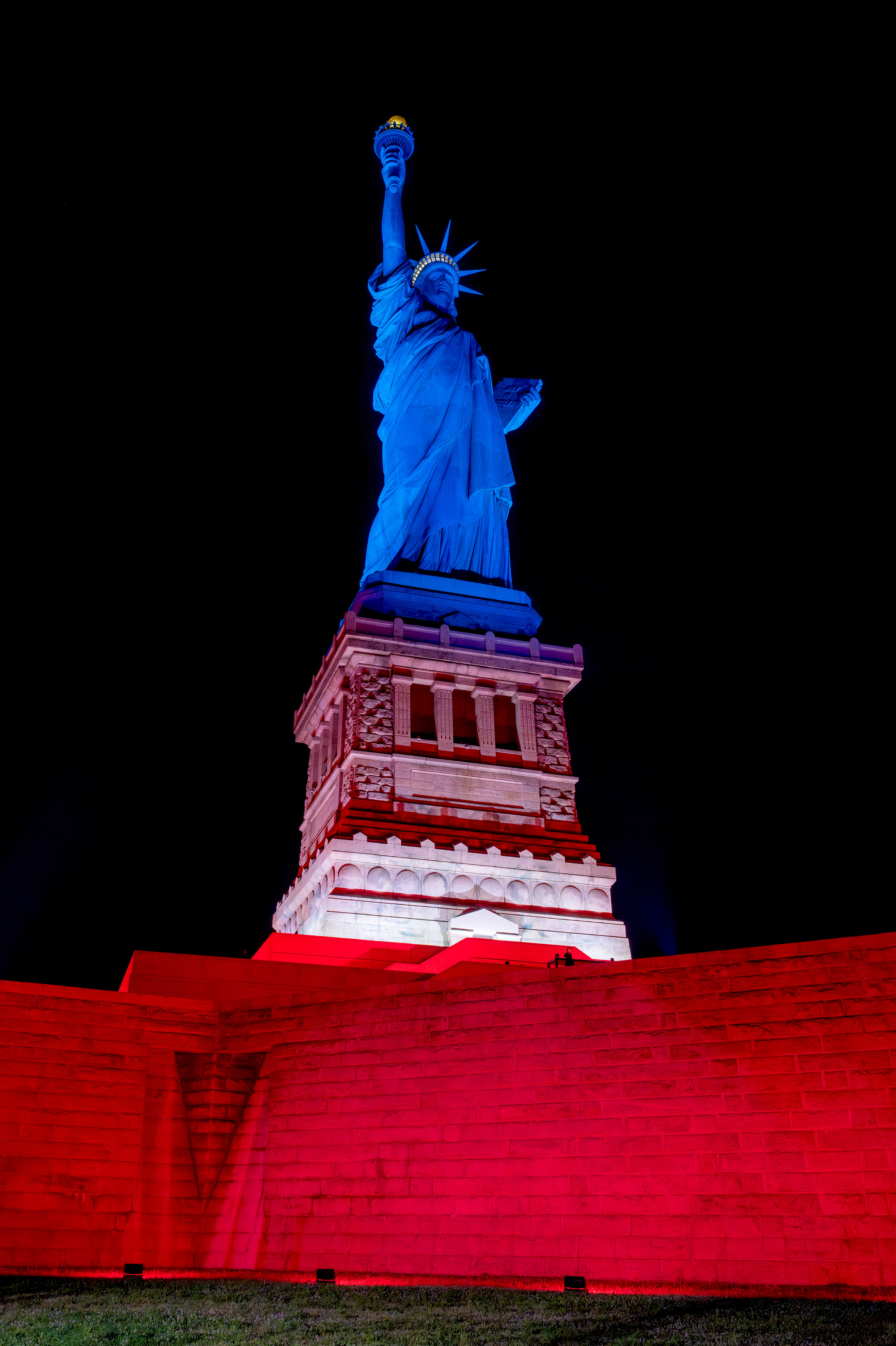
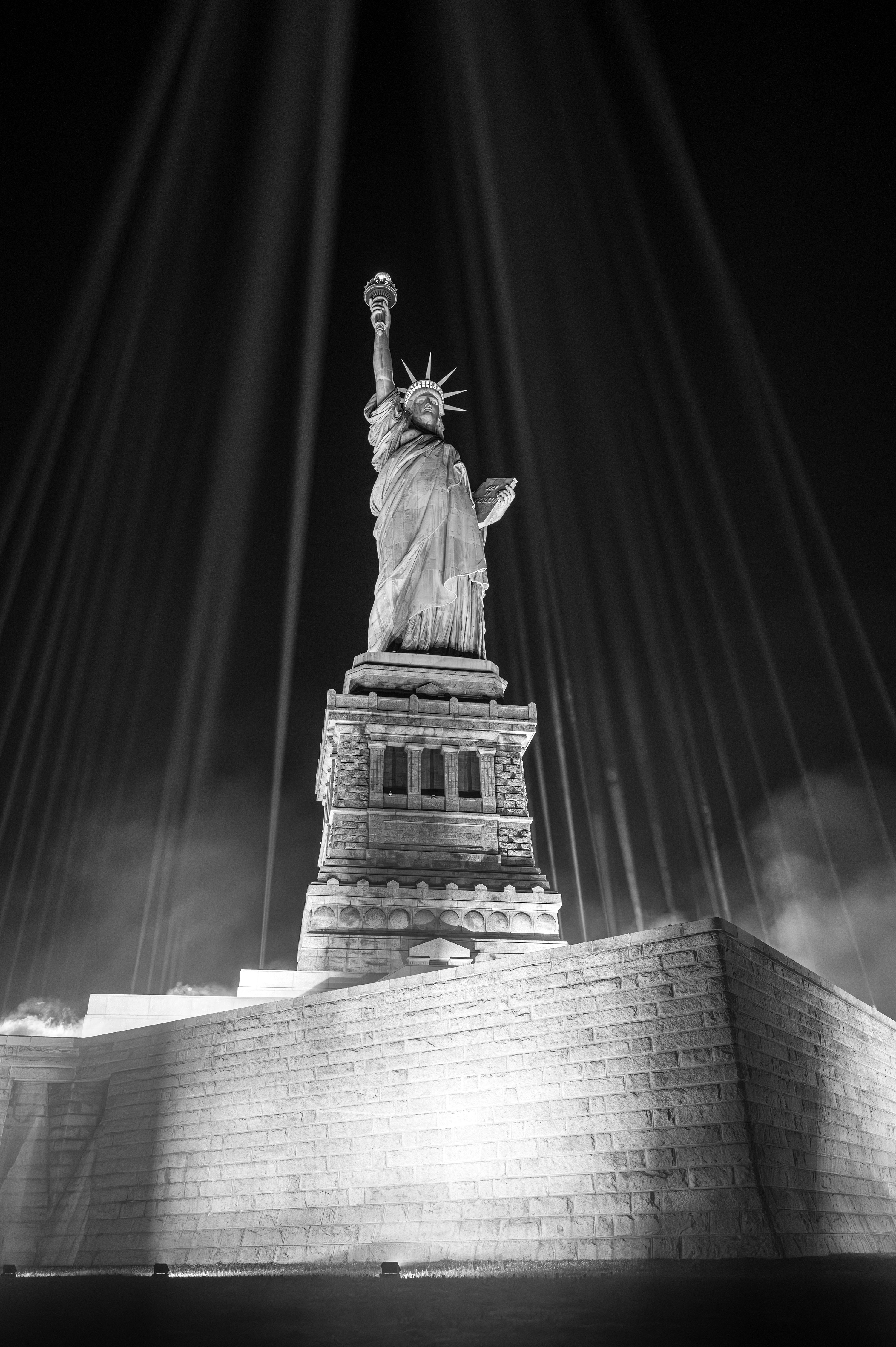
Versailles, the gates of the château, form the first square of the Monumental Jeu de l’Oie, and we decided to carry the game all the way to the Statue of Liberty, which marks its 140th anniversary this year, a symbol of the Franco-American friendship born 250 years ago.
You chose Bastille Day to unveil this piece, which will later travel to Paris. Was that deliberate?
Completely. From the very beginning, when we thought about celebrating this independence, it made sense for it to happen in New York. We always wanted to start on this side of the Atlantic, then try to bring the project elsewhere, especially to France. But it was always conceived as a New York project first. What’s wonderful is that it’s happening for Bastille Day, in the natural continuation of the events of 1776. The timing and the place, L’Alliance New York and Madison Avenue, thanks to Tatyana Franck, are perfect.
L’Alliance New York invited Gwendoline Finaz de Villaine and Pauline Lévêque to unveil their street art for Bastille Day 2026, because they conceived an interactive art installation to bring New Yorkers together in a living dialogue between two cultures that have shaped one another for 250 years.
Tatyana Franck, President of L’Alliance New York
In what way does street art, like the work of JR, Christo and Jeanne-Claude, and now the piece you’ve signed with Gwendoline Finaz de Villaine, create a dialogue between cultures, between individuals?
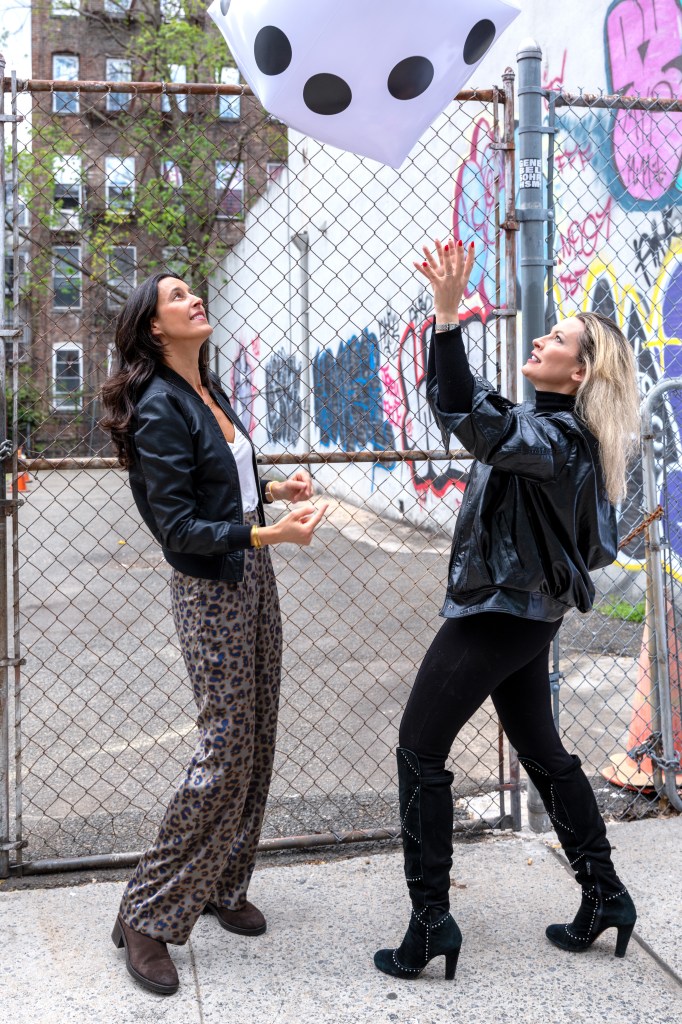
The key here is the public’s ability to become part of the installation itself. The Monumental Jeu de l’Oie is an interactive work. It’s a way of freeing art, of turning it into an adventure, of making it accessible, of ensuring everyone can take part. If you can become part of the piece by becoming a game piece yourself and actually playing, it turns into a global, public creation. It’s a way of making art accessible to everyone. It’s joyful, it’s a family adventure. Even the dice are funny. It’s a bit like the labyrinths of the eighteenth century: we’re invited to take part, to become, for a moment, an ephemeral part of the art itself.


The public also knows you through your illustrations, especially the page you now draw for Paris Match, once Sempé’s. That’s work as an illustrator, and your pieces are usually framed and hung on walls rather than installed on the asphalt of a street, whether that’s Madison Avenue on July 12 or the Trocadéro esplanade in Paris on September 19, 2026. Did that dimension factor into how you created these 63 drawings?
Since I knew from the start it would be an artwork interpretation of a board game, each square had to stand on its own, so in a way the principle was the same as what I usually do. The big difference from a drawing in Paris Match is the single story I have to tell within one drawing published in a magazine. Here, what was beautiful about Monumental Jeu de l’Oie was the way all the drawings had to work together to tell the larger story. Each square of the game was thought through individually, but I had already mapped out where each one would go. I wanted it to flow, without repetition. I followed the logic of the Parisian snail, the shape of the arrondissements: I started at Versailles, then the Champs-Élysées, the Concorde, the Louvre, the Tuileries, the Opéra, the Hôtel de Ville, Orsay, the Eiffel Tower. A great deal of work went into it. And to cross from Paris to New York, I drew a bateau-mouche.
Through its 63 squares, I wanted to transform the game into a poetic metaphor for democracy and freedom. As in life, we move forward together, encounter obstacles, help one another, and keep believing that liberty is a collective adventure.”
Gwendoline Finaz de Villaine, co-artist of Monumental Jeu de l’Oie
So, this sequence of drawings leaves nothing to chance; it’s a path to follow.
Every square was carefully considered. I alternated the monuments following the pattern of the Parisian arrondissement snail. And once you cross to New York by boat, you land in Brooklyn. From there, a taxi takes you to the Chrysler Building, and so on. It all flows until you arrive at the Statue of Liberty. The squares have meaning, an order to them.
At what point in your life did you decide to become an illustrator?
I’ve always drawn. My father is a painter. I grew up in his studio, painting the backgrounds of his canvases, though I never did anything with it myself. Then I met my husband, who loved what I did and encouraged me to keep going. I was a journalist for about fifteen years, for Marie Claire, Le Journal du Dimanche, Paris Match. When I was pregnant with my son Georges, who’s sixteen now, I started drawing for him. It grew into a series of books, Beep Beep, in both French and English: Beep Beep in New York and Beep Beep in Paris.
Your two loves again. Paris and New York.
And then a friend asked me to co-author a book with her, Say Bonjour to the Lady. From that book on, it was the butterfly effect. A man asked me to draw the view from his apartment as a gift for a friend. I began doing more and more of these illustrations. Real estate agencies asked me to create closing gifts, a street, a façade, a building, to give their clients. I collaborated with Ladurée after that, and I never stopped drawing since, for others and for myself.


How is illustration different from drawing?
One day I was having lunch with Martine Gossieaux, Sempé’s widow, and I told her I was an illustrator. She told me that Sempé was never an illustrator, but someone who draws, an artist, a cartoonist. I thought the word cartoonist sounded almost dismissive, but she explained that a cartoonist is actually free: he creates the drawing himself. An illustrator illustrates what’s asked of them; they don’t create it. So really, I should say I’m a cartoonist, not an illustrator. When I draw for the page that was once Sempé’s at Paris Match, I’m a cartoonist, an artist. When I take on a collaboration, I’m an illustrator.
Not a painter?
Perhaps it’s easier to be recognized as a painter, working in acrylic or oil. But that’s a matter of materials, of technique, because at heart, the work is the same for everyone. As for someone like Gwendoline, who works in the abstract, I couldn’t tell you how she sees things, but every artist has their own vision. So do I.
So within the Monumental Jeu de l’Oie, are you a free artist or an illustrator?
An artist.
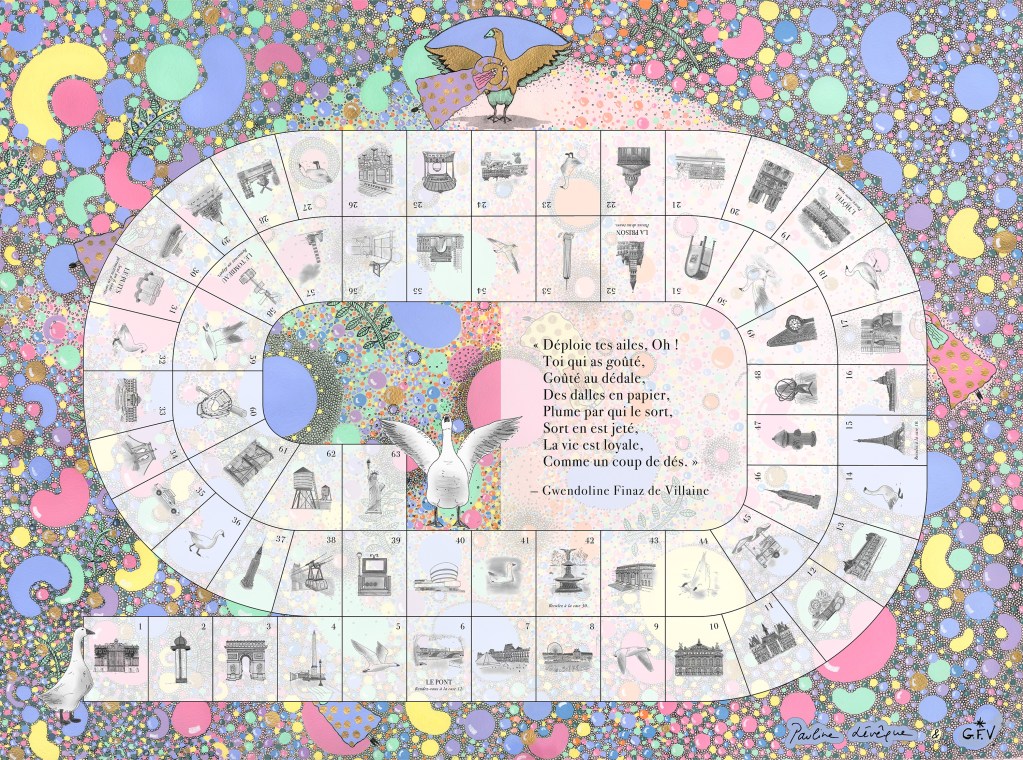
Monumental Jeu de l’Oie, inaugurated in New York on July 12, 2026, will be presented on September 19, 2026, for the first time in Paris, on the esplanade of the Trocadéro, in sight of the Eiffel Tower and of the shorter version of Bartholdi’s sculpture, standing on Swan Island on the Seine. Installed in 1889 to celebrate the centennial of the French Revolution, she of course looks toward her New York harbor big sister.
Two cities united through a torch, history, and values, and once more, art.
You who have tasted
tasted the maze
of paper tiles.
Feather, through which fate,
fate is cast.
Life is fair,
like a roll of the dice.
Magic spell
Gwendoline Finaz de Villaine
Leave a Reply