

Make Art, Not War
A conversation with New York artist Dove Bradshaw
Exhibition at ARTe VallARTa Museo, Puerto Vallarta, Mexico | Zero Time, Zero Space, Infinite Heat
February 2nd – May 5th, 2024
Meet with Dove Bradshaw at ARTe VallARTa Museo on February 3rd, 2024
The first time I visited the apartment of conceptual and minimalist artist Dove Bradshaw, I barely let my eyes wander around the living room, busy with paintings and books everywhere, a piano in a corner, and an old chess table. Two friends had asked me to join them for an intimate dinner at Dove and her husband’s, artist William Anastasi (also known as Bill), Upper West Side home, blocks away from Morningside Heights and the Hudson River. I vividly recalled this evening when, years after, Dove invited me back, this time to show a few people some of the artwork soon to be exhibited in Puerto Vallarta at ARTe VallARTa Museo. “A first for this museum, which had presented only Mexican artists before,” and a premiere in Mexico for this artist, whose work is part of the permanent collection of the Centre Pompidou in Paris, and the Metropolitan Museum and MoMA in New York.
As I was riding the Broadway-Seventh Avenue 1 train to 103rd Street, I remembered how her husband—who passed away just a few weeks ago—had described his famous Subway Drawings. Every time Bill Anastasi would sit in a subway, he would balance a piece of paper on a board on his knees, close his eyes, and let a pencil or felt-tip pens draw lines as the train would vibrate, and lurch when it stopped at a station, and depart again until he reached his chosen destination. During my only dinner with him, his wife, and our shared friends, Bill told endless stories of his daily chess games with composer John Cage. Dove Bradshaw, Anastasi, Cage, and his companion, choreographer Merce Cunningham, formed a band of artistry and friendship for years, all dedicated to conceptual art, along with Carl André, Sol LeWitt, and Robert Ryman.
The early 20th-century iconic building where Dove lives is typical of this Manhattan neighborhood. The large porte cochère and the arched entrance are reminiscent of the grandeurs of the nearby San Remo, Ansonia, and Dakota buildings. I was immediately transported into a film set and, on my way to the elevator, I promised myself to record details visually; I had even brought a camera with me to snap a few pictures.
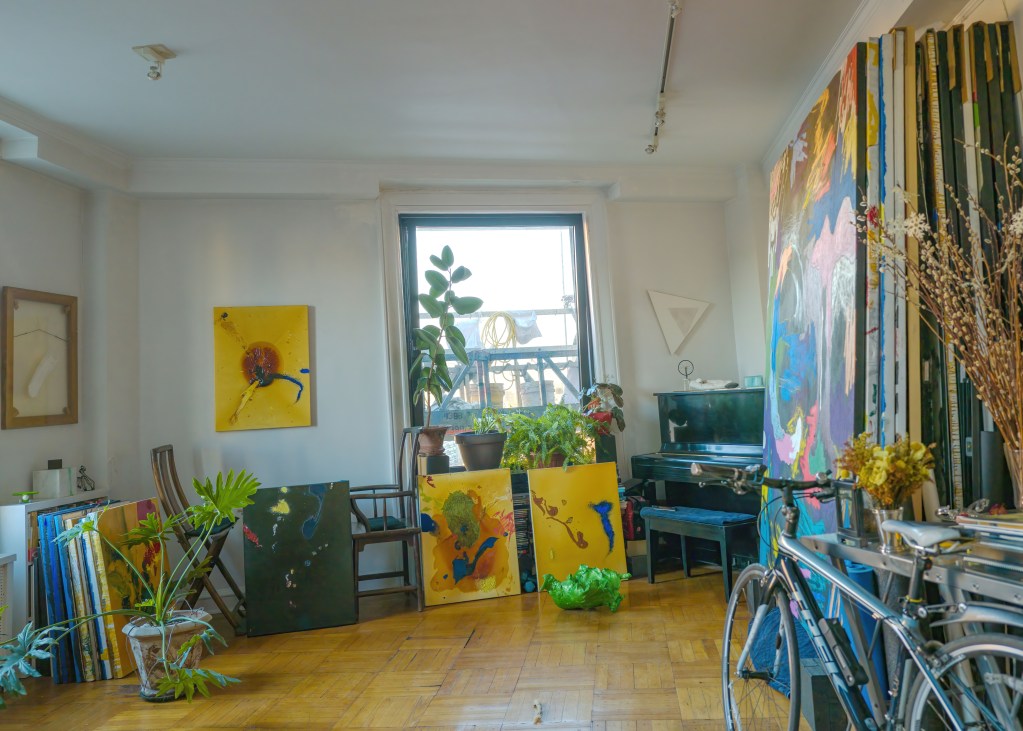
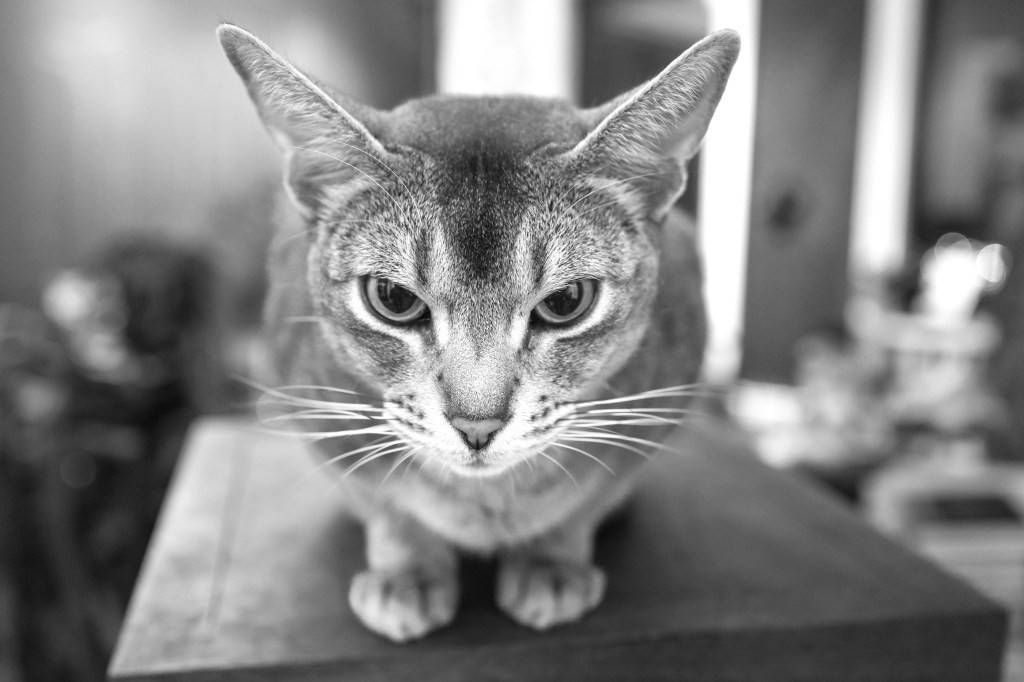
The entrance of Dove’s apartment opens to a large white column. On the right, a yellow Roy Lichtenstein painting catches my eyes, and Dove puts my coat on an empty foldable walker to the left of the door. A series of blown-up-shot bullet sculptures coated with car paint occupy every chair around a long table. On the wall, Dove tells us, hangs Bill’s last piece: the final Bababad Painting, a series begun in the mid 80s illustrating the first thunderword in Finnegans Wake consisting of a hundred letters, painted one by one in groups or alone in some forty paintings. Canvasses are everywhere, in the corridor leading to a bedroom filled with hundreds of vinyl albums and a bathroom, itself an art room, with a large curtainless window opening high above opposing buildings onto the East Side of Manhattan. The kitchen has barely aged since the 1920s. Books filled the shelves as much as cooking instruments do, audiotapes have their own side room, and there is Sasha the cat too.
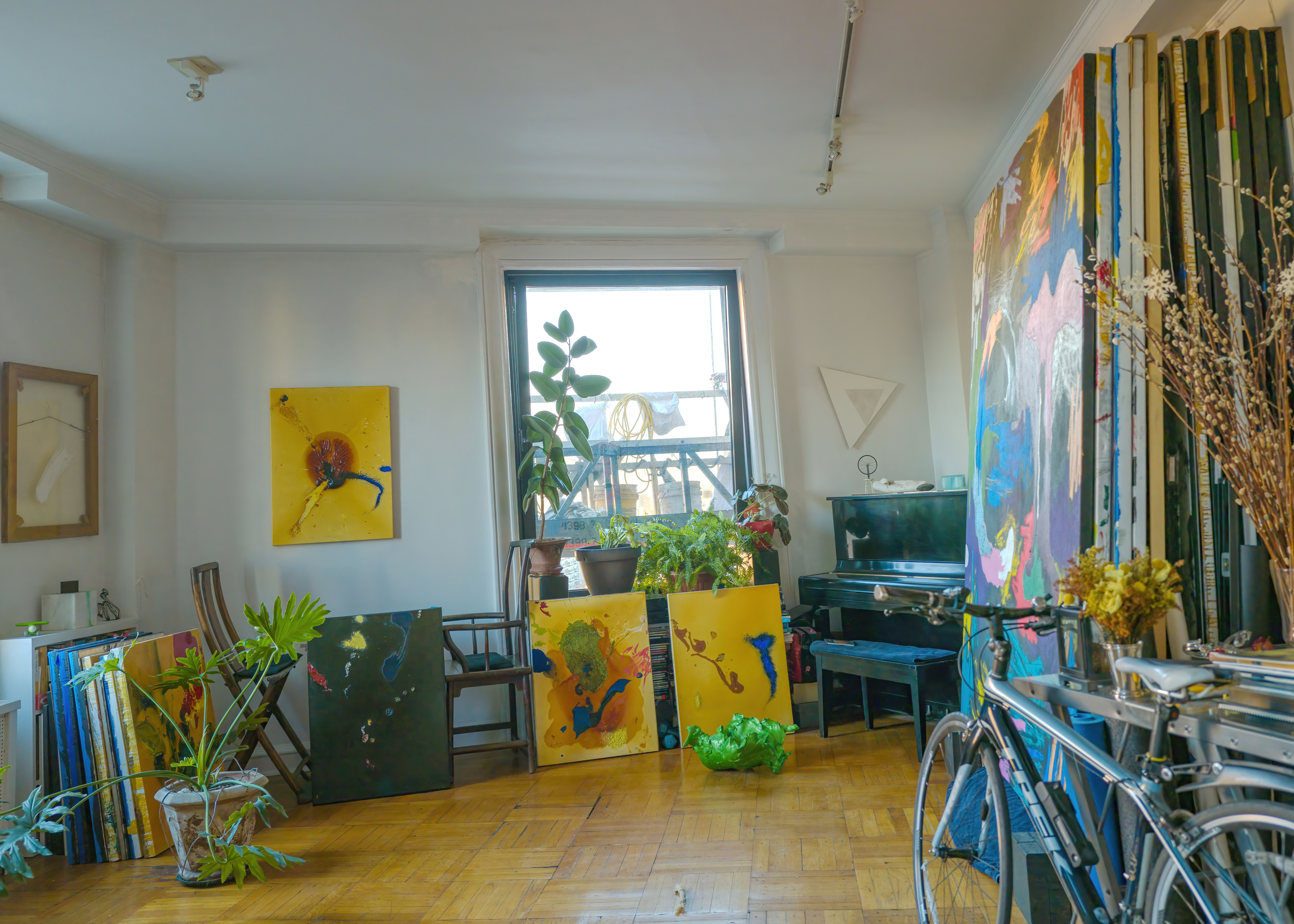
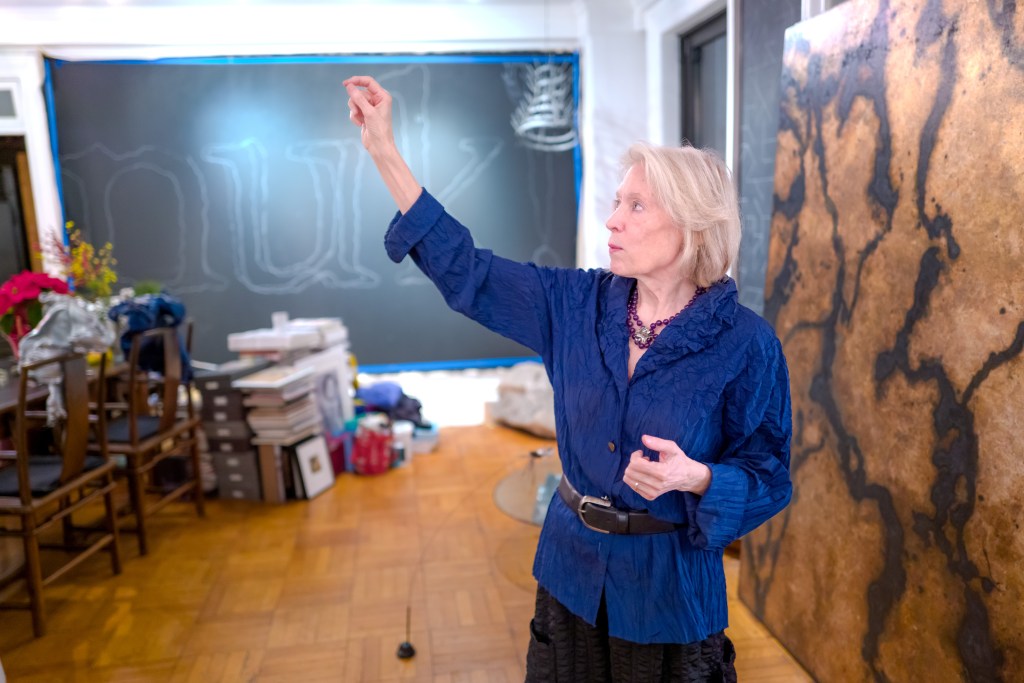
Paintings from the Guilty Marks series stand by a piano next to elements of the silver Contingency Painting series, on which Dove has thrown a variety of organic matter such as sticks or roots marking them with a chemical that creates its own colors and shapes.
Dove is an ‘enabler’ artist; she lets chance transform, cut, draw, decide, and sway the artistic destination of objects.
“The things that happen in (Dove Bradshaw’s) work are, so to speak, full of not her determination but its determination, such as chemical change, or gravity,” John Cage once wrote. “She used the word event, whereas she is interested in an undefined freedom of action for the chemistry. Of not doing anything. …what we find in Dove’s work is constant experimentation with things to see what happens when you do that.”
Underneath a window, a large round glass panel transforms another blown-up painted sculpture of a shot bullet into a coffee table/artwork.
Another artwork of this series is on permanent display in Washington D.C., Dove tells me: “Our Secretary of State Anthony Blinken has the largest Spent Bullet I’ve made in his State Department office coated with a beautiful steely-silver 2019 Porsche paint.”
“Make Art, not War,” she says later when I come back to sit among the bullets to interview her in the middle of what no longer seems to simply be a home, art studio, and storage, but an apartment with a life of its own, with memories becoming the source of new artistic creations.
I then realized I was the ephemeral guest of an idiosyncratic art place, “an ArtHome,” in constant evolution, and drawn there by chance.

How were you chosen for this exhibition in Mexico?
A curator at the Philadelphia Museum had wanted to write a blog about my work in the collection, and it was one of these pieces that John Cage had shown in his Carnegie International exhibition in 1991. Most artists invariably show only their own work, but Cage wanted to associate himself with the younger generation of women artists, and I was among them. The Philadelphia Museum has been a great repository of works from the Duchamp, Cage, Cunningham, Jasper Johns, and Rauschenberg lineage. My work fits under that umbrella. Cage had shown at Carnegie International 12 pieces of mine, 12 of his and 12 of two other women artists, Mary Jean Kenton and Marsha Skinner, and now two of these works I did will be shown in Mexico.
Wasn’t it quite unusual at the time for a male artist to be interested in the work led by women artists and to be championed by no less than John Cage?
Well, it was certainly an honor. Cage had been associated with Dorothea Tanning, Louise Nevelson, and Annie Albers of the older generation. My feeling about the 20th century would be that the first part is Marcel Duchamp’s with the found object—l’objet trouvé—and the second half would be Cage, who created in 1951 the work of what he called Chance Operations. Cage was the philosophical king of the art world in the latter half of the 20th century and had introduced Marcel Duchamp to the younger artists, including Rauschenberg and Johns. For me, Duchamp and Cage are the brackets of 20th century art—two historical revolutions that changed art profoundly and that continue to prompt artists.
I discovered Chance in making art and I suddenly realized how much better it was as a free-standing sculpture.
Dove Bradshaw
Mexico, where you are about to show a selection of your works, is also Frida Kahlo’s country, one of the leading artists of the 20th century and undoubtedly one of the most celebrated nowadays. Interestingly, one of the first people, outside of Mexico and the United States, who valued Frida Kahlo as a visionary artist was Marcel Duchamp in France, on the eve of the Second World War.
Diego Rivera was the famous artist in the family, and she was definitely a second-class citizen. But now, the world pays more attention to her than to him. There are a couple of reasons for that. One is that she did portable paintings, and he did murals. The other is that hers were personal, and his were political and generic. And the personal work affects an individual much more.
Is your art more on the personal or the political side?
I don’t see it as political except for the bullets, which does have a political aspect. My work is philosophical, and even the bullets have a philosophical point, one might say, of turning something horrible into something beautiful and physically retiring it from its deadly purpose. So, that certainly is a utopian political idea. I first made these works as jewelry to be worn on the outside of the body, and then once 3D printing became possible in the 2000s, I could create sculptures and blowup these little one inch .38 caliber bullet slugs that had been shot in target practice by the New York City police.
How do you define beauty?
In the eye of the beholder, but for me, I feel that it needs to be sensuous. The Spent Bullets are coated with luscious car paint colors or in one case with white gold leaf. For instance, one of them here has a Ford 2023 minty green.
My work is philosophical, and even the bullets have a philosophical point, one might say, of turning something horrible into something beautiful and physically retiring it from its deadly purpose.
Dove Bradshaw
One of these blown-up bullet sculptures is on every dining table chair where we sit–First, their shape.
They are curled. Because in the police firing range the way, the bullets explode is after piercing a paper target 60 feet away, they hit a metal sheet behind it and then ricochet onto another metal sheet. They slide into the sand, are retrieved, melted down, and reused as bullets. They’re not retired; they’re reused. They are only out of circulation is if they’re shot in action or the minute few I or others have collected. In my case, the Utopian gesture involves taking them out of circulation. In a wildly different context curling onto the backs of these 18th-Century Chinese chairs, I thought of it as a surrealist setting. A painter might see them as giant daubs of paint.
All placed on every chair around your wooden table!
I had them as our Phantom guests during the pandemic. Yeah, I have kept this indulgence since, and when anybody actually sits, we take them off. I will miss them tremendously because they’re going away for five months. Now I’ll always have to have them, or I’ll feel denuded.
They are sent to a country that has a complex relationship with violence, just as the United States does.
Javier Estevez, our Mexican art dealer and owner of Mascota Gallery in Mexico City, once said—whether this is true—that there are only two legal gun stores in all of Mexico. In the U.S., one can buy a gun in a hardware store, for instance, just 10 miles away from our country house in a tiny town with a winter population of 125 in the Endless Mountains of Pennsylvania. An ordinary hardware store in another tiny town! It’s harder to buy unpasteurized milk! But a gun? In any hardware store. We have a surfeit of guns. Our killings in churches, grocery stores, synagogues, every spectrum of life, a theater, a nightclub, but significantly no money is involved, just sheer anger. The anger level in this country is off the screen and not really duplicated anywhere else in the world to the scale that we have.
Your message is one of a powerful, clear voice.
Make Art, Not War.
Our Secretary of State Anthony Blinken has the largest Spent Bullet I’ve made in his State Department office coated with a beautiful steely-silver 2019 Porsche paint
Dove Bradshaw
Make Art, Not War! Now, I have John Lennon’s song ‘Imagine’ in my mind.
(The phone rings. Dove does not answer it but leaves the table for her kitchen to boil water for tea. I follow her)
When I thought about Yoko Ono and John Lennon‘s Make Love Not War, I definitely was referencing their 1969 Bed-In. Just about everybody can make love. That’s easier to do than art, except if you’re six or seven years old. Then everybody is an artist. A study found that for five-year olds before 1st grade, 98% might have qualities that go into genius: meaning they are willing to experiment and sustain doubt for longer periods of time. In other words, to play. Every year after that the percentage goes down to where most adults don’t sustain doubt if they can help it. It’s too unsettling. However, artists who are working on a painting often have to struggle to resolve the work that they’re working on. They have to sustain that doubt and uncertainty in order to sustain a lifetime of work that won’t bring them money for a good many years, if at all, and will only be remembered and collected in museums if they’re the very lucky ones. This narrows the field of possibilities for making art instead of war. Fewer people have that kind of persistence, or passion or madness. But if you come from a culture–we were talking about Mexico–where you live closer to the earth, closer to a long, continuous culture of food, pottery, or basket weaving and the like where one trusts one’s feelings—it may come naturally, except in a major city where you’re plucked outside on a concrete street, isolated from the continuum of nature. Significantly Bali has no word for art, but everything there is aesthetic.


Artists who are working on a painting often have to struggle to resolve the work that they’re working on. They have to sustain (…) doubt and uncertainty.
Dove Bradshaw
This is Art versus Artisanal. When does an artisanal object become an artwork?
If it’s authentic, it’s art. People are always wondering where artists get their ideas. It is sometimes a very specific prompt. Some ideas just pop into my head; they’ve been gestating, and all the groundwork is there. If you saw the lineage of the concept, you would think it was very nuts and bolts and simple-minded. See these eggs that I will be showing in Mexico: one day, a woman who was very grateful to my father gave me this mussel shell with a little clasp made in the early teens of the last century. She was a WWI nurse and it had been given to her by a very grateful patient. I thought it could be a container for an amulet of some kind. I was intrigued when I saw it. I was 15 or something. So, for my first work, I wanted to take an eggshell, which would have had a little hinge and be a container.
(This is my turn to be interrupted. Men appear on the other side of her windows, two high-rise window washers on their way down to the street. End of a workday.)
So here is what art is: a desire to reproduce and add a new dimension to an object?
Or rewrite the rules as Duchamp and Cage did. Art is not a trodden, tried, and true path. You can learn a little bit at school, but you can’t learn those qualities of sustaining, experimentation, persistence, and the ingredients it takes to come up with an idea. With my lack of ability when I made the wax for the amulet case, the hen’s egg didn’t fully form leaving a giant hole in the bottom, and thus it couldn’t be made into a prosaic little case. Instead, I discovered Chance in making art and I suddenly realized how much better it was as a free-standing sculpture. It was certainly more interesting than if it had been a little container.
In a utopian world of global peace, the world John Lennon enticed us to imagine, conceive, and create; how would you continue as an artist? Would you be out of a job?
Oh, not at all. The Spent Bullets I’ve created are one part of what I do, and people don’t even have to know that they’re bullets. They may just like the shape.
Art is not a trodden, tried, and true path.
Dove Bradshaw
What else are you exhibiting in Puerto Vallarta?
One artwork is titled Plain Air. I took some birds that had just been given to me, doves for my namesake, and let them fly free in my first apartment when I was an art student. As a child I never had birds because I always had cats. But this time, I lived alone as a ‘catless’ art student. They would perch on my cookbooks in the kitchen and destroy them with their droppings. One day, bicycling home from school, I found a bicycle wheel. Growing up in New York, I had seen Duchamp’s famous Ready Made, a bicycle wheel bolted upside down so it could spin on a stool and was fascinated by it. I hung the wheel by a steel cable horizontally through the axle from the ceiling for their perch, and the birds immediately sought refuge and slept there. They made it spin when they landed on it and left the cookbooks alone. Gradually then, they destroyed the floor. After I saw a Zen Archer’s target at a Columbia (University) demonstration of Zen Archers, I made a replica of a target and nailed it to the floor. It fits their practice which is to embrace the beauty of the form of the execution and not whether they hit the bullseye. It’s about process and not results. Even here, a lot of my work is a process of arriving at what I was doing as a discovery. And along the way I had to change my mind. As I said, I had that prosaic idea in the early egg piece and then had to change my mind about what it was.


So, chance leads your artistic process, every time.
I did the eggs first because I was taking a jewelry class at The Boston Museum School. Then I got the birds. I nailed the target to the wooden floor, and the birds dropped on it. I cleaned everywhere else but this one spot. At first, I was just solving the needs of the birds without thinking of making any kind of art. When the birds collected wire, yarn, and hair from my brush around the studio for a nest—which in fact they used to hatch their egg—I realized that all the while an art piece was being made with their collaboration. I only had them for about nine months before I went to California for the summer, so I let the three go step by step as they went of their own accord out my open third-story window. It became a work for a school critique that year, and later, 20 years later, I showed it formally in a gallery and then at the Mattress Factory in Pittsburgh the following year and then at PS1 in New York.
This exhibition will show paintings.
One of the series will be the silver paintings. I again used a form of chance. In a few cases failed paintings from The Guilty Marks became Contingency silver paintings. I would cover them with leaves if I didn’t like what I did. For their composition I would then throw on these sticks that I would collect in nearby Riverside Park and then paint a chemical called Liver of Sulphur. When I was younger, I used to let them tarnish all the way to getting almost black. Now, being in my 7th decade, I like to hang on to the image. Pyrite was sometimes attached to the surface when the varnish was on. It’s a nod to the Italian artist Lucio Fontana, who used stones and glass.


What draws you to Mexico?
I’ve never exhibited there before and love Mexican art, also its artisanal crafts and food. In other words, culture.
If there was one common thread besides making art, not war?
Which is not common throughout.
It’s not common throughout. I see your ability to constantly move forward within your work, to keep it organic. Especially when you’re dissatisfied with one, you take it in entirely different directions.
Waste not one knot in a small New York City apartment; you can’t waste a canvas and a stretcher. Everything has to function here.
When did you decide to become an artist?
When I was five. My father was teaching me to read. He had the facility to draw like Claes Oldenburg, so he’d write a word and then draw a picture of what it was. It looked particularly dramatic to watch him do that. So, for instance when he wrote the word ‘pan,’ and like any child, learning something that was not recognizable was not as engaging as, say, the image of a pan being made before your eyes. I thought right then that it would be great to have that ability.
You create art all around you. You’ve even thought of your apartment as an extension of your art.
Even the way I’ve set the table. I think of everything in an aesthetic way.
There were three in my marriage.
Dove Bradshaw
It is impossible not to speak about your late husband, who was also an artist and a leading Conceptual artist, William Anastasi, a.k.a Bill. You also mentioned John Cage. Were you the lonely woman in that group?
I had a very odd experience. I’d like to say two things about it. One, that I felt like Princess Diana. There were three in my marriage. Only we weren’t married then, but we lived together. We only married in 2015 and had already been together for 42-43 years.
You said you were three in your marriage?
Because of John Cage. Bill played chess with John Cage every day for 15 years when they were in the same city. That’s at least two hours of play and one hour of round-trip travel. Seven days a week. Before that, we were free birds. I taught at the School of Visual Arts one day a week at night and at Riverside Church another night and Bill taught two days. Being artists though anything we did all day was up to us five days a week.
But you had friends, didn’t you?
I had no friend who was a woman or anybody my age at the time mainly because of devotion to my work and two of my closest friends had become anthropologists who had traveled away from the city where they had studied. Bill was 16 years older. John was 40 years older, and Merce (Cunningham) was 36 years older. With these two gay men and Bill, we would go out. We would do everything together: films, Broadway shows, art exhibitions, and, of course, concerts, shopping for food and cooking, and I would play chess in the round robins with Dorothea Tanning, and pianist Grete Sultan who premiered some of Cages’ work and others.
How did John Cage and Merce Cunningham respect you as an artist?
John and Merce treated me as an equal artist. They didn’t talk down. We had been chosen as co-equal Artistic Advisors of Merce’s Company which we did actively for just shy of ten years.
Which, again, was very much ahead of its time.
Well, I was so much younger. I used to joke with them. I’d say, ‘I still have the bad work to move through… You guys are already finished.’ They may have liked that spirit, this sort of playfulness. John would also say about Bill and me that we were like “spring.” They were older and enjoyed being around younger people. And we became like a family with its joie de vivre.
Did you co-create with Bill? Did you influence one another?
We did influence each other; but we didn’t work together. Even when we were Artistic Advisors of Merce Cunningham, we didn’t collaborate. We were such different people, such different artists but there was certainly a conceptual overlap. A couple of times when I had a failed painting, I gave it to Bill who used my groundwork to good effect, and he used silver leaf once for a rare figurative painting and I riffed on his self-referential photography once using my eyeglasses as frames filling the lenses with tiny photos of what one would see through them. In other words, the arms. I titled it (A)Muse a pun and a nod to Bill who was a muse as I was for him.
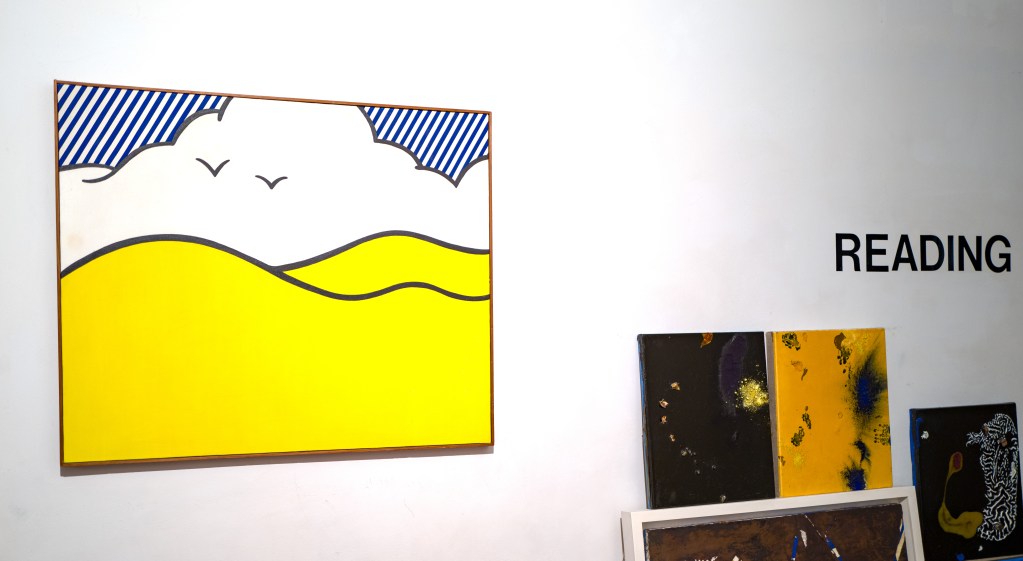
But you did create an artwork together: an experience among three artists: Lichtenstein, Bill, and you. And as a coincidence, you and Bill have lived in the same building where Lichtenstein grew up as a child.
Oh, this? (Dove points out the Lichtenstein painting on the wall leading to the apartment’s corridor). Well, you could say that. I was just a technician. Anybody could have done what I did. It was a beloved painting of Roy’s from 1978 titled Landscape, which was his only painting of his at the time in his South Hampton living room, but Bill had turned it into a conceptual piece of his. And Roy was willing to assist him. So Roy and I copied it together, though I worked like any of his studio assistants. Bill showed it in a Couples show that year at PSI where he and I participated. I showed my own work. Now without the replica of Roy’s living room wall complete with molding the way Bill had presented it, it’s in Roy’s Catalogue Raisonné no different from any work farmed out to his assistants. Maybe though it’s more his than most since he painted over half, let alone had the idea and traced the original himself. It’s a comic book cartoon of a couple of rolling dunes with two gulls flying against a giant cloud that one might find in Donald Duck’s generic thirties beach house. There are only two. I don’t know whether any other work of Roy’s was ever duplicated.
Yes, but you did it.
I’m not saying it took artistry. It took a certain amount of skill to go within the line that’s all.
Were you and Bill competitive?
Competitive? There were some aspects of that. Sometimes, I would show my work to my art dealer—whom I later got to show Bill’s work—and Bill would play the piano so loud we had to talk over him. There was a dominating presence then, but Bill and I were very encouraging to one another. We loved each other’s work for the most part. We also used to fight over Wall Space though because this is our gallery.
A gallery and an apartment all at once.
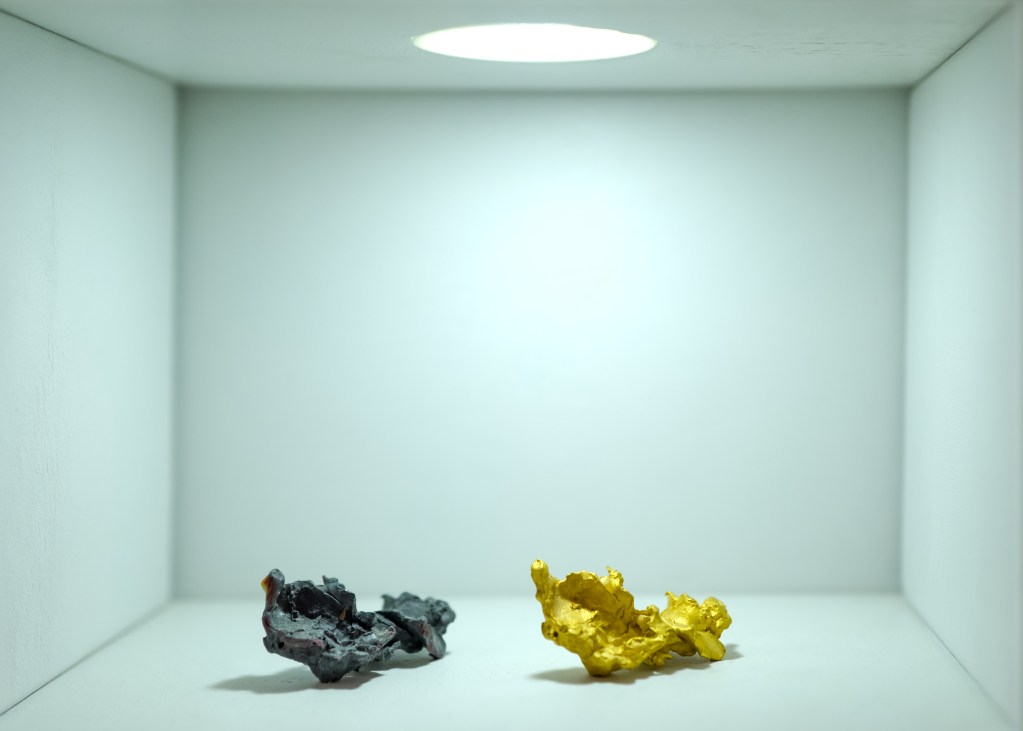
For instance, originally at the entrance I had wanted to show this two-small-bullet artwork, one a shot slug, the other its copy in gold that’s encased in a miniature box set into this column but on the entrance side. Bill nixed it. He said, ‘No way that we’re going to have a lit piece of yours the first thing that people see. No way.’ In other words, he wouldn’t allow it.The back side wasn’t free then. There had been a glass separatory funnel hung from the ceiling at the time that released seven drops a minute onto a limestone block directly below it for some twenty years. However, when Sasha (the cat) broke it sometime later, I was able to do it.
Link to ARTe VallARTa Museo: https://artevallartamuseo.mx


Leave a Reply to Davis BirksCancel reply